
Roof Damage Repair
Flashing Failure Repair in Federal Way, WA
The superintendent's first act on a flashing complaint is to pull the plan and mark every place the roof meets something else: walls, curbs, pipes, drains and edges. Those are the joints, and a membrane is only as tight as its joints. Then he takes a hose and starts at the bottom, wetting one detail at a time and watching the ceiling or the inside of the wall. The detail that leaks shows itself in minutes, and the repair begins there.
In Federal Way, WA, where rain falls on about 155 days a year in nearby Tacoma and arrives mostly from October through March, a failed flashing does not stay quiet for long.
How do we find the flashing that is leaking?
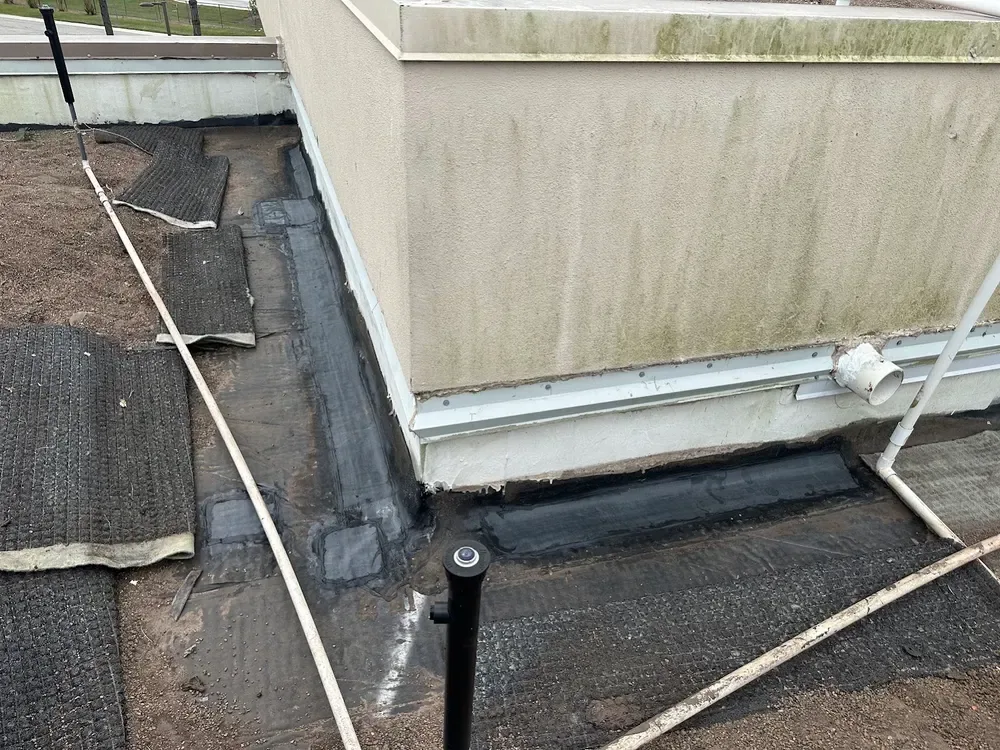
We walk every joint with the plan in hand. Base flashing at parapet walls, counterflashing, curb corners, pipe boots, drain collars and edge terminations all get a close look. We press on terminations, probe sealant and check fasteners for backout. Cracks, gaps and lifted laps are photographed against a numbered plan.
A water test confirms which detail is feeding the leak. We wet one detail at a time, from the bottom up, with someone inside watching the stain. Interior marks seldom sit under the opening, so the test saves the cost of repairing the wrong joint. A commercial roof leak repair follows the same order.
The walk also looks for the cause of the failure, because a joint that fails twice has a reason. Movement in a wall, a curb that settled, a pipe that expands in the heat and a membrane under tension all pull on a flashing. A seam failure near a flashing often points to the same movement. We note the cause on the plan, and the repair is detailed to allow for it.
How much of the flashing comes out?
The limit is the extent of the failure plus a margin into sound material. A split corner may need only that corner rebuilt. A termination that has pulled away along a wall may need the whole run replaced, with the counterflashing reset. We mark the cut lines in paint and cut back to material that is clean, dry and well attached.
Wet insulation behind the flashing is common, since water enters behind it first. A core at the base of the wall shows the extent. If the board is wet, it is cut out and replaced before new flashing goes on. Sealing over a wet base only hides the problem, and the leak returns with the next rain.
Metal gets the same inspection. Counterflashing that has rusted, bent or lost its sealant is replaced, and the reglet in a masonry wall is cleaned and resealed. A new strip set into a failing mortar joint will leak again. Where the wall itself is cracked, the mason is told, and the roofing scope waits for the wall repair.
What does a flashing job need on site?
The crew needs access to the walls and curbs, a place to stage membrane and metal, and sometimes a lift for tall parapets. On a retail center along Pacific Highway South, the lot is live, and the lay-down yard sits at the edge, away from entrances. At the Woodbridge industrial park on the former Weyerhaeuser campus, the yard is larger and the truck lanes matter.
The staging drawing shows the lay-down yard, the container and the route. Tenants receive a notice with the closed entrance and the loud hours. Where the flashing is at a wall shared with another tenant, both tenants are told, and the plan notes the shared line.
Tall parapets and rooftop curbs call for fall protection set before the first tool goes up. Guardrails or tie-off points are placed to suit the work, and the crew leader reviews them at the start of each shift. Hatches and ladders are secured when the crew leaves, and the key returns to the manager.
How do we keep a repaired joint dry through the day?
Only what can be sealed by evening is opened. A single curb or a run of wall flashing is usually completed in a day, so the dry-in is simple: clean the area, dry it, install the new flashing and test. For larger runs, each section is sealed before the next is opened.
In the same Green River corridor, Auburn is heaviest in November and December and lightest in July. In wet months, the crew works under a tent or waits for a dry window, since adhesives and sealants will not bond to a damp surface. A temporary seal goes on if the repair cannot finish, and it is tested with water and logged.
The first task every morning is a look at the previous day's work, joint by joint, before new work begins. A flashing that was sound at sunset can fail overnight if a seal was marginal. The crew leader photographs each joint and compares it with the evening image. Anything that moved is redone before the day goes on.
What makes a flashing last?
Three things: a sound base, a mechanical termination and a sealed top edge. The base is clean, dry and attached. The termination is a bar, a clip or a reglet fastened at the spacing the manufacturer calls for. The top edge carries counterflashing or sealant that sheds water. A flashing that relies on sealant alone fails when the building moves.
Corners need formed pieces or welded covers, not a fold. Pipe boots need clamps and sealed bases. Curbs need height above the roof surface. Edges and coping are fastened to resist uplift, with the 74 mph of the November 2024 bomb cyclone at Enumclaw, the highest in Washington, as the yardstick. A skylight and penetration flashing rebuild follows the same rules.
Materials should match the roof. A flashing for a thermoplastic membrane is welded membrane or pre-molded accessory. A flashing for modified bitumen is a compatible cap sheet or a reinforced liquid. A flashing for EPDM is a cured or tape-seamed strip, and a ponding water repair at the base of a wall often goes with it. Mixing systems creates joints that never bond, so we confirm the roof type at the cores before ordering material.
How do we prove the repair held?
Each rebuilt joint is tested before the crew leaves. We probe edges, pull-test sealant adhesion and, where the system allows, spray the joint again with the hose while someone watches inside. The crew leader photographs each joint before, during and after the work and marks finished items on the roof plan.
The closeout package lists what was rebuilt, with product data and photographs. It also lists the details left alone, and notes when to look at them again. Owners with buildings across Federal Way City Center and Kent can use the same format, and a related wind damage repair record shares the file.
The warranty stays in view. A manufacturer may limit who can repair flashing or require notice of repair work. We read the warranty before we start and follow its repair details, so the new flashing does not create a reason to dispute coverage. The closeout file records the terms and the notice, if one was given.
Commercial Roofing Questions
How do you know which flashing is leaking?
A hose test, one detail at a time, from the bottom up, with someone inside watching. The detail that leaks shows itself, and the repair begins there.
Can sealant fix a failed flashing?
As a stopgap, sometimes. A lasting repair rebuilds the flashing with membrane and a mechanical termination, because sealant alone fails when the building moves.
What if the insulation behind the flashing is wet?
It is cut out and replaced before new flashing goes on. A core at the base of the wall shows the extent.
Can flashing be repaired in the rainy season?
In dry windows, or under a tent. Adhesives and sealants will not bond to damp surfaces, so a temporary seal holds until conditions allow.
How long does a flashing repair take?
A single curb or corner takes part of a day. A long wall run takes a day or more, depending on access.
Send the roof plan and a photo of the stain
Send the roof plan, a photo of the stain and the location of the leak. We will walk the sequence, staging and tie-ins with your team before a number goes on paper.