
Roof Systems
TPO Roofing in Federal Way, WA
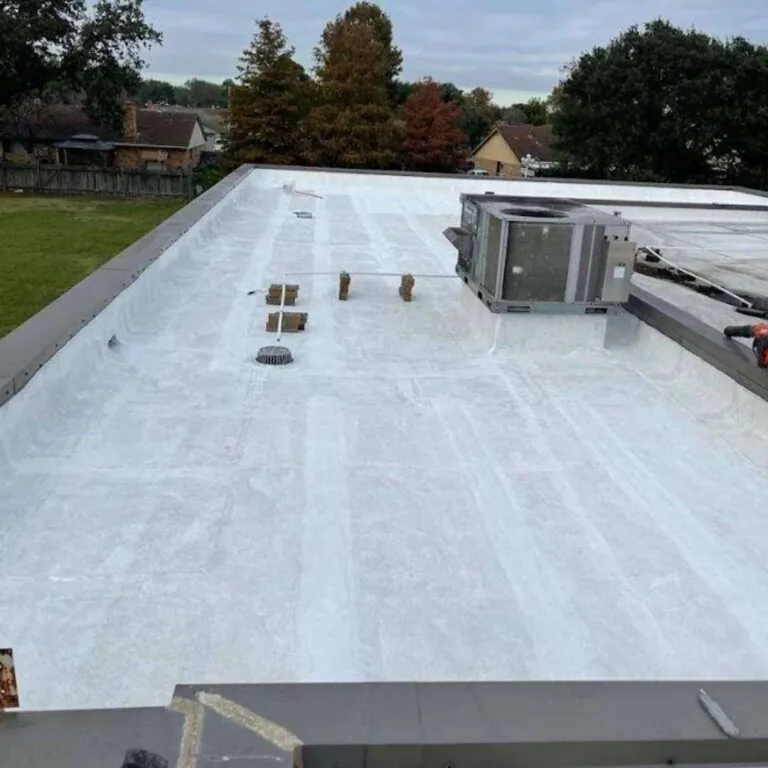
On a TPO job, the superintendent walks the deck and checks the substrate before anything else. TPO is a thermoplastic single-ply membrane: white or light gray, welded at the seams with hot air and attached to the roof by adhesive, fasteners or ballast. It is a common membrane for new warehouses and offices, and for a replacement over a worn built-up or modified bitumen roof, on a Federal Way, WA building. A good TPO roof is mostly a good substrate, good welds and good edges.
The steps run in order. Cores and a moisture scan settle what stays. Tear-off limits go on the roof in paint. The crane pick, tear-off, insulation, cover board and membrane follow, each section dried in the same day.
What goes under the membrane?
TPO needs a clean, dry, firm base. On a replacement, that is usually new polyiso insulation topped with a cover board, fastened or adhered to the deck. On a recover, it is a cover board over the old roof once cores prove the old insulation is dry. We walk the deck and run a fastener pull test in several places to find out what the deck will hold, then write the attachment pattern around the results.
The cover board does more work than its thickness suggests. It protects the insulation from foot traffic, helps resist hail and tool drops, and gives the membrane a flat bed. We list it as a separate item on the plan. A roof insulation and cover board package sized to the energy code also sets curb heights and drain bowl depth, so the numbers get checked before the crane is booked. If the thicker package leaves a curb too short for a proper flashing rise, the curb is raised or the unit is reset, and that line sits in the bid from day one.
Attachment depends on the deck. A steel deck takes fasteners and plates at a set spacing, a concrete deck takes adhesive or masonry-rated fasteners, and a wood deck takes screws with a different pattern. We confirm the deck type on the walk, run pull tests at the perimeter and corners, where uplift is highest, and write the pattern to the weakest result we find, not the average.
How are the seams made and checked?
TPO seams are fused with a hot-air welder that softens both surfaces and presses them together. A good weld has a clean bead along the edge, a uniform width and no cold spots. Dirt, moisture or low temperature can spoil it, so the crew wipes the lap, tests a sample weld each morning and adjusts the machine for the day's conditions.
After welding, the crew leader probes every seam edge with a screwdriver-style tool, looking for gaps and skipped sections, and marks any flaw for a repair weld. Cuts for curbs, drains and pipes are flashed with prefabricated boots or formed pieces, and the flashing is welded to the field sheet. We photograph the seams and details before they are covered, and the photographs go into the closeout record. A PVC roof gets the same discipline with its own welding settings, and an EPDM roof swaps the weld for adhesive or tape at the seams.
Test welds are cut, not just looked at. Each morning the crew welds a sample, lets it cool and peels it to see whether the bond tears the membrane rather than separating cleanly. A clean separation means the machine settings are off, and the day's work waits until they are fixed. The result goes in the daily log with the temperature and the machine setting, so the crew leader can show what the welds were made under if a question comes up later.
What holds the edges in a windstorm?
Wind lifts membranes from the perimeter. A storm on the scale of November 2024, with 74 mph at Enumclaw, tests every edge. For TPO, the edge is held by a metal flange or termination bar fastened through the membrane, with sealant above and, in high-exposure zones, extra fasteners in the perimeter and corners.
We fasten edges as if that wind is coming back. At the perimeter and corners, fastener spacing tightens, the metal edge is attached to the substrate and the membrane is tied in with a welded cover strip. After any storm, we walk the edge and look for lifted metal, torn welds and loose bars. A wind-damaged roof usually starts failing at an edge or a corner, so those areas are checked first in every closeout walk.
How do we sequence a TPO job in the wet season?
Rain totals 37.1 inches a year in Auburn, with November and December wettest and July driest, and about 40.8 inches in Tacoma across roughly 155 wet days. TPO welds best on a dry membrane at moderate temperature, so the best window is the dry summer, with July the safest. In October through March, we size each day's tear-off to what we can seal by evening and stage rolls and boards under cover.
A day on the roof starts with the forecast and ends with a temporary seal at the work limit. Water stays out of the insulation, and the membrane goes down on a dry surface. If rain arrives before a section can be sealed, the crew stops tear-off and finishes the seal first. A commercial roof replacement and a recover follow the same sequence, and at closeout your superintendent and our crew leader cover every tie-in side by side.
Where does TPO fit on local buildings?
TPO suits large, low-slope roofs with many penetrations, including new buildings at Woodbridge and the warehouse and distribution space of the Kent Valley, Auburn and Fife. It also works on a retail roof, such as those along Pacific Highway South and at The Commons, when rooftop units sit on curbs across the field. Each building has its own drainage, edge height and unit count.
The 2021 International Building Code with Washington amendments, effective March 15, 2024 for the latest change, and the 2021 IECC for commercial buildings frame the design. An owner in Kent or Federal Way West Campus starts with the roof plan and schedule, and tie-ins are walked with that owner's superintendent.
Commercial Roofing Questions
Is TPO the right choice over a PVC or EPDM roof for my warehouse?
For a clean, dry warehouse with no grease or chemical exhaust, TPO is a sound and economical choice, and it is easy to repair and weld. PVC is better where fats or chemicals reach the roof, and EPDM suits some low-slope roofs with few seams. We review the building's use before recommending.
How long before a TPO membrane needs seam repairs?
It varies with workmanship, exposure and traffic. A well-welded roof can run for many years with few repairs, while one with poor welds or heavy foot traffic needs attention sooner. We inspect after the first winter and at regular intervals.
Can TPO go over an existing roof?
Yes, when cores show dry insulation, the deck can carry the weight and a cover board is installed between. A wet or failing roof should be torn off instead.
What does a reflective white surface do in this climate?
It lowers surface temperature in summer, which helps cooling loads and eases membrane stress. The effect is modest in a mild climate, so the choice should rest on the full roof design.
Who flashes the curbs and pipes?
Our crew flashes each penetration with a prefabricated boot or a formed flashing welded to the field sheet. Mechanical trades coordinate the equipment, and we coordinate the dates.
Send the roof plan and the project schedule
Send the roof plan, the age of the existing system and the project schedule so we can walk the sequence, staging and tie-ins with your superintendent before a number goes on paper.