
Roof Systems
PVC Roofing in Federal Way, WA
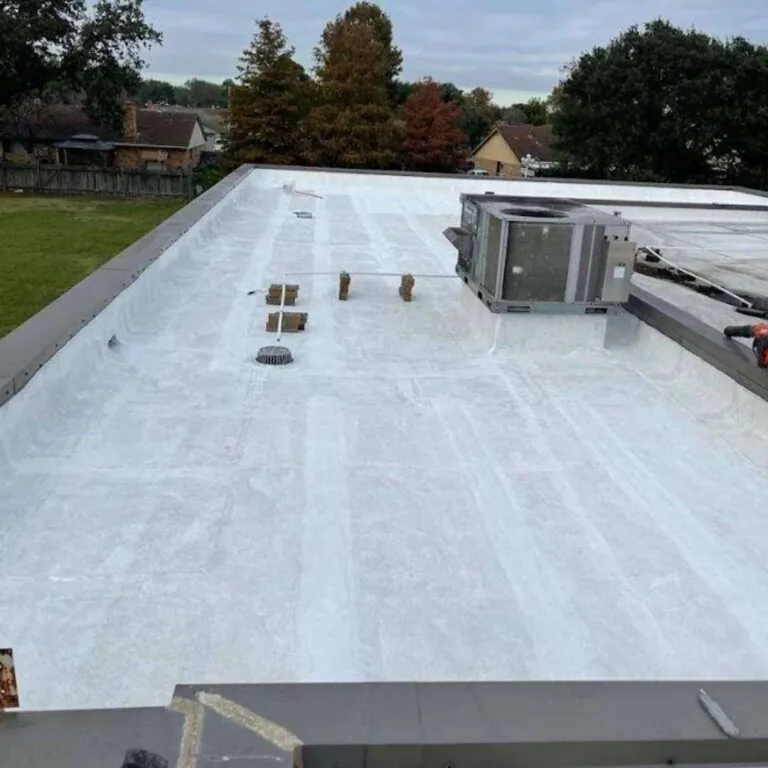
Our superintendent starts a PVC job by finding out what lands on the roof besides rain. Kitchen exhaust, laundry vents, lab hoods and process stacks all drop fats, oils or chemicals on a membrane, and PVC is chosen for exactly that reason. It is a reinforced thermoplastic sheet with hot-air welded seams, and it shrugs off many substances that soften other single-ply roofs. On a Federal Way, WA roof with heavy exhaust, the question that changes the plan is which vents sit where, and how far the discharge travels.
After that the job runs in its usual order. What stays is decided by cores and a moisture scan. Tear-off limits go on the deck in paint. Then the crane pick, the tear-off, the insulation and the membrane, with each section dried in the same day.
What makes PVC the choice for grease and chemicals?
PVC resists many animal fats, vegetable oils and a range of airborne chemicals better than most other single-ply membranes. That is why restaurants, food-service kitchens, hospital laundries and labs commonly get it. The membrane has a flexible top layer that shrugs off contact, and a reinforced core that carries the load. A KEE membrane blends in a ketone ethylene ester to improve resistance further. PVC is not impervious, though. Some solvents attack it, and long exposure to hot discharge can stain and stiffen the surface near a vent.
We map every exhaust on the roof and ask the mechanical contractor what comes out of it. Then we choose the membrane, the flashing and the walk pad to suit. Where discharge is heavy, we add a splash pad under the vent or a deflector that keeps the discharge off the field. A restaurant roof is the textbook case, but the same thinking applies to a hospital or a clinic with its own exhaust.
How are PVC seams made, and what ruins them?
PVC seams are fused with hot air, the same principle as TPO but with different temperature and speed. A good weld shows a uniform bead and no cold spots. Dirt, grease and moisture on the lap ruin it, so the crew wipes the lap with the right cleaner and test-welds a sample each morning. When a sample peels cleanly at the interface, the machine gets adjusted before any more field welds.
Cold slows the work. PVC stiffens in low temperatures, and in the shoulder months we warm the area, shorten rolls and slow the welder to keep the bond sound. After welding, the crew leader probes each seam edge and marks gaps for a repair weld. Penetrations get prefabricated boots and corners welded to the field sheet, and we photograph the details before they are covered. The same steps appear in a TPO roof job with different settings.
Thickness and reinforcement vary by product, and so does the way the sheet is attached. Fully adhered PVC bonds across the field and gives a smooth surface. Mechanically attached PVC is held by fasteners and plates along the seams, which suits large roofs. We choose by deck type, wind exposure and the use below, and we record the attachment pattern on the plan so a later repair crew knows where the plates sit. Cut ends of the reinforcing fabric are sealed so the core cannot wick water, which matters most at field-cut openings around curbs and drains.
What do healthcare and institutional roofs need?
Local hospitals include St. Francis and a Virginia Mason medical center. A roof over a medical building carries air handling, exhaust and sometimes roof-mounted equipment that must keep running. It also sits over spaces where a leak cannot be tolerated, so the roof is worked in small sections, each sealed by evening, with the facility's engineers in the loop.
The plan names air intakes near the work, shutdown windows for equipment, noise limits and infection-control rules. We cover intakes during dust-producing steps and arrange deliveries outside peak hours. Hospital loops and parking decks have their own limits for lifts and trucks, and the site sketch shows the crane pick, the lay-down yard and the path of every delivery before the first one arrives. Closeout covers every tie-in with your superintendent on the roof. Owners of clinics and care facilities can pair this work with a reroof on an occupied building, where the section plan and the facility's schedule are written together before the crane arrives.
How does the wet season shape a PVC job?
Tacoma gets about 40.8 inches over roughly 155 wet days and Auburn 37.1 inches, and July is the driest month in Auburn. A wet day is a wet day for welding: moisture on the lap prevents a bond. So the best weather for membrane work is the dry summer, and the work in other months depends on dry windows and quick drying.
Monthly averages in Federal Way stay below 71.6°F, so heat puts little thermal stress on the membrane. The more common enemy is water in the wrong place during construction. The crew opens only what can be sealed by evening, keeps insulation covered until the membrane goes on and gives every edge a temporary seal. If the forecast turns, tear-off stops and the seal comes first. A small leak found during the job gets a planned repair before the new sheet covers it, and the repair is logged with its location, so the closeout record matches the roof.
Where does PVC show up locally?
Pacific Highway South, the main commercial strip, carries much of the retail, including The Commons and the Pavilions Centre. Where a building on that stock has food-service tenants, exhaust is a concern, and PVC fits it. The Kent Valley, Auburn and Fife add warehouse, distribution and aerospace manufacturing buildings, some with process vents that point toward a chemical-resistant membrane.
The scope settles insulation levels and curb heights against the building code Washington amended for 2021 and the matching commercial energy code. An owner in Federal Way City Center or Fife can send us the roof plan and exhaust list, and we walk the sequence with their superintendent.
Commercial Roofing Questions
How do I know if my roof needs PVC instead of TPO?
Look at what vents onto it. If cooking exhaust, lab hoods, laundry vents or process stacks discharge fats, oils or chemicals near the roof, PVC is the safer membrane. If the roof is clean and the use is dry storage or offices, TPO costs less and performs well.
Does grease damage a PVC roof?
PVC resists many fats better than other single-ply membranes, but heavy discharge can still stain it, and grease holds dirt. We install splash pads under vents and recommend a cleaning schedule near them.
Can PVC be welded in cold weather?
Yes, with care. We warm the lap, slow the welder and shorten the rolls so the membrane stays pliable, and we test-weld before the field work. Below the manufacturer's limit, we hold the work.
Can a PVC roof be repaired after a puncture?
Yes. We clean the area, cut a patch with rounded corners, weld it and probe the edge. The repair is photographed and marked on the plan. If the roof is old, we check that the membrane still welds well.
How is a hospital roof kept dry during the job?
By working in small sections, sealing each one before evening and planning around air intakes and shutdowns. The facilities team signs off on each day's area, and the crew leader walks the seals every morning.
Send the roof plan and the exhaust list
Send the roof plan, the list of vents and exhaust, and the project schedule so we can walk the sequence, staging and tie-ins with your superintendent before a number goes on paper.