
Industries We Serve
Roofing for Real Estate Investors and REITs in Federal Way, WA
Before an investor closes on a building in Federal Way, WA, our superintendent walks the deck with the lender's checklist in one hand and the plan in the other. Cores get cut, fastener pull tests get run and the drains are cleared and watched through a rain. The walk answers three questions the underwriter will ask: how much life is left, what needs money in the first year, and what will fail first if nobody touches it. Every finding is photographed against a numbered plan.
An owner holding several assets wants the same answers in the same format. We give one page per roof, with remaining life, first-year items and a recommended order of work, so the portfolio can be compared line by line, whatever the age or system of each roof.
What does a pre-acquisition roof walk produce?
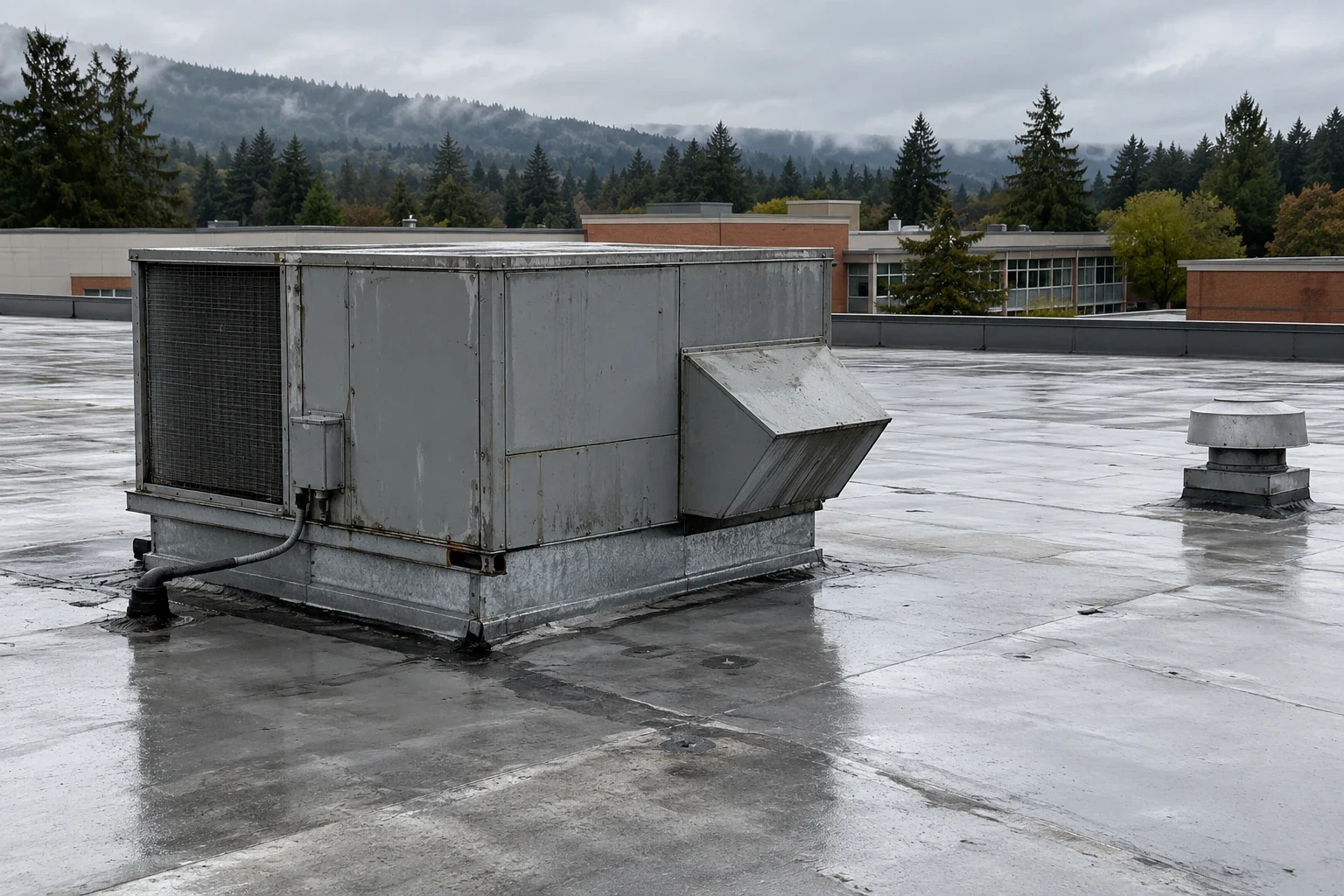
A pre-acquisition walk has a fixed output. It records the roof type and layers found at the cores, moisture readings across the field, seam and flashing condition, drainage performance and the count and condition of penetrations. It also lists past repairs, because a cluster of patches in one area says where the roof has failed before.
The result is a due diligence roof survey that a buyer can use in negotiation. Items split into three groups: immediate repairs, scheduled work in the hold period and long-range replacement. Each carries a photograph, a method and a price range, so the investor can set a reserve without guessing. Remaining life comes from the cores, not from the age of the roof.
Leases matter to the walk, even though the roof does not read them. We ask who is responsible for the roof under each lease, because that decides who approves the scope and who receives the report. A single-tenant building may have an owner who pays and a tenant who must be told. A multi-tenant building has a manager in between. The report names each party and what each receives, so a lender, a tenant and an asset manager can each see their own page without reading the others.
How do repair, recover and replace compare over a hold period?
The comparison depends on moisture and on how long the owner will hold. A roof with dry insulation and local defects is repaired, and the repair buys years at low cost. A sound roof with a long hold ahead may take a coating or a roof recover, which avoids tear-off. A roof with wet insulation across the field needs tear-off, and the limits are marked in paint before pricing.
We price the recommended path and the next step up. An investor planning a sale in three years may choose a repair and a documented condition report, and one expecting to refinance within the hold keeps the repair path documented so the lender sees condition at closing and again at the next walk. One planning a ten-year hold may choose replacement with a longer system life. The numbers, the cores and the photographs sit side by side, so the choice is clear.
Substrate condition shapes the limits as well. When the tear-off exposes the deck, the crew leader walks it again. Steel decks get checked for rust and fastener condition, and wood decks for soft spots. Any deck repair is priced as a unit rate in advance, so a discovery under the old roof does not stall the job or surprise the owner.
How is an industrial asset staged?
Industrial assets bring dock lanes and truck courts into the plan, as at Woodbridge, where new buildings are going up on part of the former Weyerhaeuser campus.
We walk the lot before pricing. The staging drawing names the lay-down yard, the container location, the truck route and the hours of loud work. For a multi-tenant asset, the property manager receives a notice for each tenant. For a single-tenant asset, the tenant's operations contact signs the staging plan. Lease structure decides whose site rules apply, so the plan names the contact who signs for the lay-down yard, the gate hours and the hot-work permit.
How does the schedule respect the wet season?
Along the Green River corridor, Auburn's rain peaks in November and December and falls to its lowest in July. Tacoma has roughly 155 wet days a year. A schedule that ignores those numbers loses days and money. Large tear-offs take the dry months, and winter is limited to repairs and small sections.
The day's opening is capped at what can be sealed by evening. The dry-in point is set by the crew leader before the first cut, temporary seals are water-tested, and every seal is rechecked when the next shift begins. The investor gets a daily photo note, which is useful when a lender or an asset manager asks for progress.
Insurance and bonding paperwork travel with the schedule. Certificates, notices to tenants and proof of the permit are in the owner's hands before mobilization, and the permit is posted on site. An inspector who arrives at the wrong moment should find a clean site and a current set of documents.
What does the energy code change on a replacement?
Washington's amended 2021 International Building Code (latest change effective March 15, 2024) and the 2021 IECC, applied to commercial buildings by Chapter 51-11C WAC, set the rules. We confirm the rules with the building department before pricing, so the scope matches what will be inspected.
Code can also change curb heights, parapet flashing and door thresholds, since added insulation raises the roof surface. We check those tie-ins on the walk and list them. Surprises at tear-off cost more than details found on paper.
What records go in the asset file?
At closeout the package gathers layer photographs, product data, warranty terms, the punch list and the next inspection date. It is written so an asset manager who never visited the site can read it. A lender, an insurer or a buyer can use the same file without a second walk.
For owners with buildings in Kent, Auburn and Fife, a roof capital plan turns the files into a reserve schedule. Property managers use the same files to run day-to-day repairs, and logistics tenants receive notice ahead of any work that touches their docks.
Warranty paperwork is part of the file. We record what the manufacturer covers, what voids coverage and who must be notified of a repair. An owner selling the asset can hand the file to the buyer and answer the lender's roof question in one email.
Commercial Roofing Questions
Can a survey be done before the inspection period ends?
Usually, if the seller grants roof access. Send the address and the dates, and we schedule the walk early enough for the findings to inform the offer.
How do you estimate remaining life?
From the cores, the seam and flashing condition, the moisture readings and the repair history. We state a range and the evidence behind it, and we say when evidence is thin.
What does an investor reserve typically include?
Immediate repairs, scheduled maintenance and a replacement line timed to the survey. Each item carries a photograph and a price range.
Does a coating make sense before a sale?
When the roof is dry and sound, a coating can extend life and give the buyer a clear record. When insulation is wet, it hides the problem and a buyer will find it.
How are tenants told about roof work?
The property manager issues a notice we draft. It names the dates, the closed entrance, the loud hours and the rooftop units that will be off for tie-ins.
Send the roof plan and the closing schedule
Send the asset list, the dates that matter and any roof plans or reports you already hold. We will walk the sequence, staging and tie-ins with your team before a number goes on paper.