
Industries We Serve
Roofing for School Districts in Federal Way, WA
Reading the calendar comes first on a school roof. The district's last day of class, the first day of the new year and every holiday between them define the windows in which a crew can work. Federal Way Public Schools, with 2,349 employees, is one of the largest employers in Federal Way, WA, and a district that size runs many buildings on one calendar. The walk of each roof, the tear-off limits and the crane pick are set against that calendar before a scope is written.
The plan we write is short enough for a facilities director to read in a sitting and specific enough for a crew leader to run.
What does a school roof walk record?
The walk records every roof level on the site. Where a building has a gymnasium, a cafeteria and classroom wings, each can have its own roof and its own drainage. We cut cores, run fastener pull tests on mechanically attached systems and photograph drains, scuppers, seams, flashings and rooftop units against a numbered plan.
The output is one page per building with remaining life, urgent repairs and a recommended year of replacement. A facilities director can set the pages side by side and rank the district's roofs by need. A roof capital plan then turns the ranking into a multi-year budget, which supports a board report or a bond discussion without guesswork.
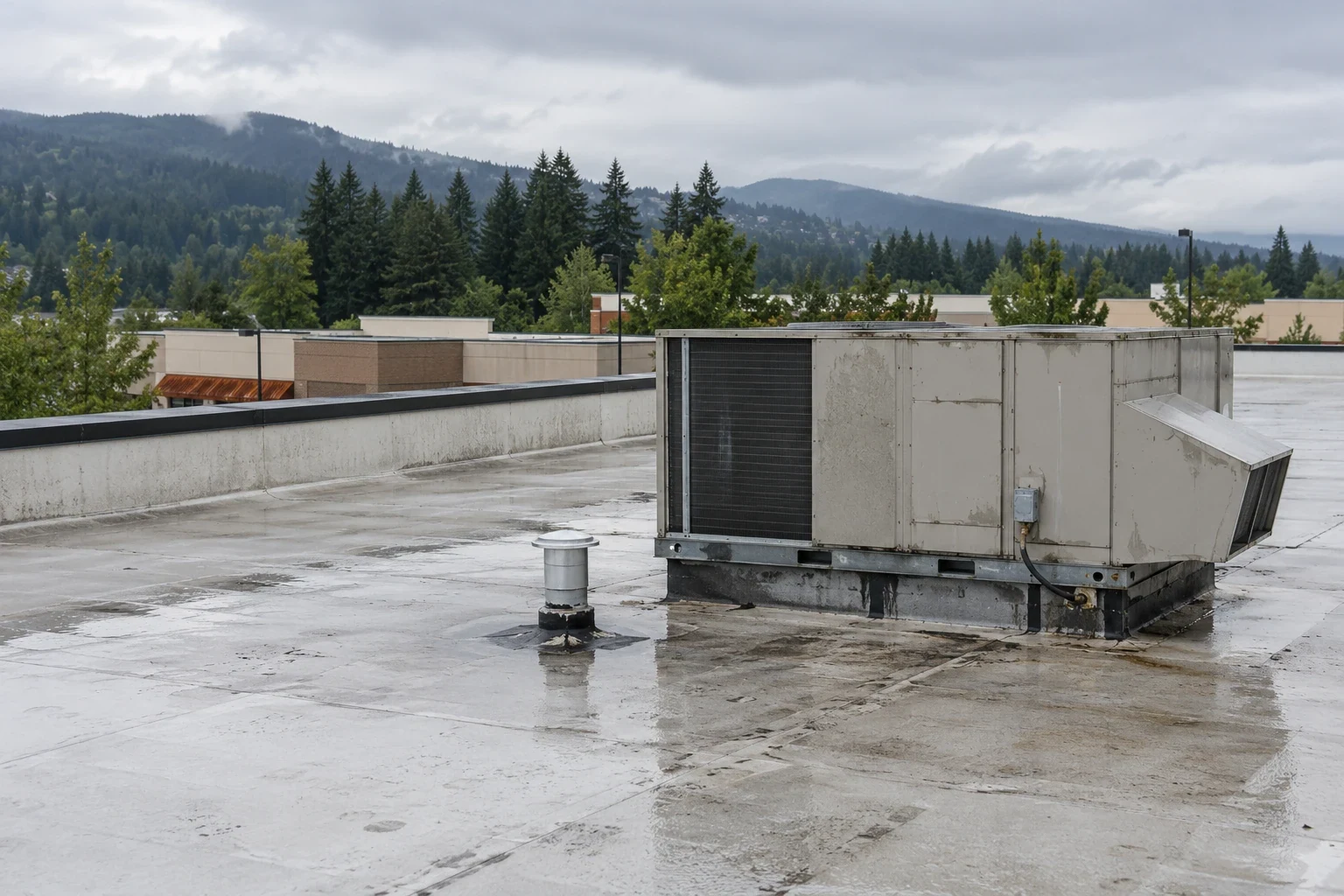
Rooftop units get a separate list. Classroom ventilation units, gym air handlers and kitchen exhaust fans each need a curb, a flashing and a service route, and the crew leader notes which ones will need a shutdown for a tie-in. The facilities director sees that list early and can book the mechanical contractor for the same week.
How do we phase a summer reroof across several buildings?
Summer is short, and the largest roofs go first. The limits are marked in paint on the deck, and the crew leader divides each roof into sections that can be sealed by evening. Where the district has more roofs than weeks, the plan splits the work across two summers, finishes one building completely and leaves the next with a temporary seal and a priority repair.
A recover over dry, attached insulation shortens the schedule because no tear-off debris leaves the building. Cores decide whether that is available. Where insulation is wet, tear-off and a full replacement are the remaining options, and the plan includes the extra days. Each scope carries a price for the recommended path and one for the next step up.
The cost of delay is visible on a school roof. A small leak in a gym or a library damages finishes and equipment, and it can close a room. The plan ranks the roofs so the worst are replaced first, and it lists the stopgap repairs for the rest, so the district is not exposed while it waits for budget. For a district weighing a phased program, occupied-building reroofing methods apply to every wing that stays in use.
Where do the crane and lay-down yard go next to bus lanes?
School sites have bus lanes, parent drop-off loops, fire lanes and playgrounds. The staging area is chosen away from all of them, and the crane pick is scheduled when no children are on the site. Fencing surrounds the lay-down yard and the container, and ladders are locked or removed at the end of each shift.
A summer reroof still has summer programs, custodial crews and maintenance staff on site. On the first morning the crew leader meets the principal or the facilities contact, walks the routes and signs the staging drawing. Deliveries are timed to avoid camp pickups and lunch deliveries. A school roof plan names these windows in writing.
Utilities and fire access are checked on the first morning. Hydrants stay clear, fire lanes stay open and gas and electrical shutoffs are located and posted. The crew leader keeps a copy of the site map in the truck and in the job shack, and the school office has the foreman's number.
How does the wet season shape the school-year schedule?
Rain peaks at Auburn in November and December and ebbs in July, and Tacoma counts roughly 155 wet days a year. The long dry stretch around the summer break is the best window, and the plan uses all of it.
During the school year, work is limited to repairs and short, sealed sections. A leak over a classroom in January needs a temporary seal in a day and a permanent fix in the next dry window. We test temporary seals with water, label them as temporary and put the permanent repair on the summer list. Drains and scuppers are cleared before the rains start.
Each section is sealed before the crew leaves, and the first task every morning is a check of the seals from the day before. On a long summer project, that routine runs for weeks, and it catches nearly every overnight problem before it reaches a classroom. Photographs of each seal go into the daily log.
How are students, staff and summer programs protected?
Safety rules are stricter around children. Barricades surround the work zone, roof hatches are secured, and fasteners and cut metal are swept from walkways each evening. Crew members wear badges and sign in with the school office, and no one enters a classroom without an escort.
Noise and odor are scheduled. Loud steps happen when no class or camp is in the room below, and adhesive work is kept away from intakes. Where a gym roof is above a summer program, the plan moves the noisy work to hours the program is out. The facilities director approves the schedule before the first day.
What does the district receive at closeout?
The closeout package names what was installed and adds layer photographs, product data and warranty terms. The punch list marks closed items and any item set for a return visit. It also gives the first inspection date and what to check, usually drains after the first heavy rain. The facilities director and the crew leader walk the finished roof together.
Districts that share files with the city or the county can use the same package for public agencies. A Federal Way district office keeps every building in one format, and the next walk starts from the last closeout.
Where a district shares a campus with another public body, such as a library or a community center, general contractors and the other agency receive the same closeout file when the roof touches both. One file prevents two versions of the story.
Commercial Roofing Questions
What does a district need to send for a roof survey?
The building list, the calendar, any roof drawings and open leak reports. We walk each roof and return one page per building.
Can a reroof finish before the first day of school?
Usually, if the scope is sized to the summer window. Larger scopes are split across two summers, with a temporary seal and priority repairs bridging the break.
How are children kept away from the work?
Fencing, locked ladders, secured hatches and a staging area away from bus lanes and playgrounds. The plan is reviewed with the principal.
What happens when a roof leaks during the school year?
A temporary seal goes on within a day when the roof can be reached safely. The permanent repair is scheduled in the next dry window.
How does the district compare bids?
Each scope lists the recommended path and the next step up, with unit prices for deck repair and wet insulation. Lines can be compared item by item.
Send the building list and the school calendar
Send the building list, the calendar and any roof drawings or leak reports. We will walk the sequence, staging and tie-ins with your facilities team before a number goes on paper.