
Commercial Roofing Services
Commercial Roof Inspection in Federal Way, WA
A roof inspection in Federal Way, WA starts at the roof hatch with a roof plan, a camera and a moisture meter. The inspector walks the whole surface in a set pattern, field first, then perimeter, then every penetration. Walking is the point. A report written from the ground or from a drone image alone misses soft spots, loose fasteners and open laps that only boots and hands can find.
The result is a written condition report with photographs, a rating for each roof area and a ranked list of work. It gives a property manager a budget, a general contractor a scope, and an owner a view of how much life the roof has left.
What does the inspector do on the roof?
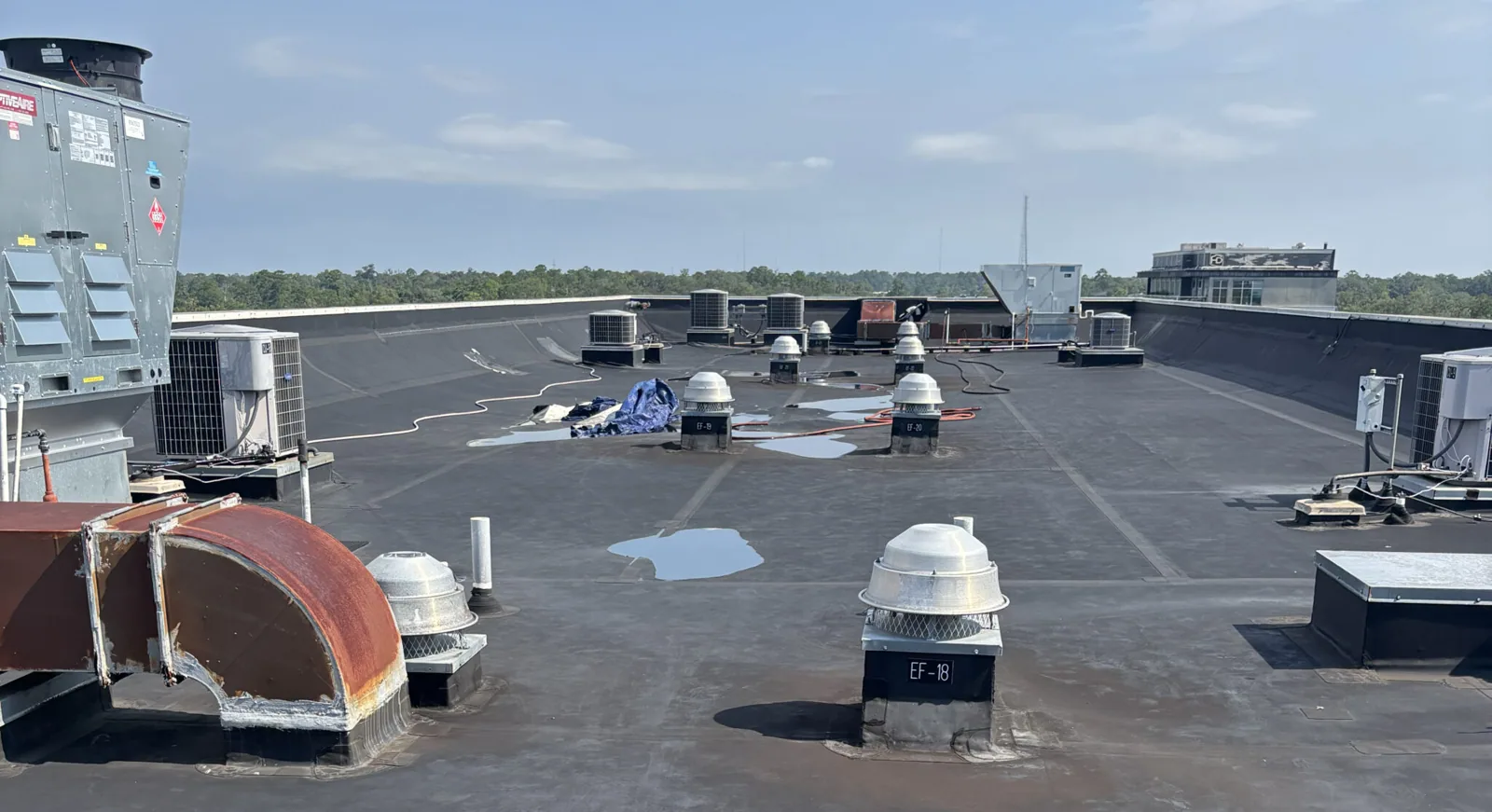
The inspector checks membrane condition, seams, fasteners, flashing, drains, scuppers, penetrations and edge metal. Every defect gets a photograph and a mark on the plan. Low spots are noted where water stands after rain, and drains are checked for debris and for the sump condition around them.
Where a roof looks suspect, the inspector may cut a core to see the layers and the insulation condition, or use a moisture meter to test a questionable area. Probes check seam edges. Roof-mounted equipment is checked for leaking lines and corroded pans that drip onto the membrane. Each finding carries a note on cause and a recommended action, so the report goes beyond a list of photographs.
Tools extend the walk. A drone survey records the overall pattern on a large roof and shows ponding and staining that are hard to see at eye level. An infrared moisture survey maps wet insulation across the field, and the cores confirm what the scan suggests. We choose the tools by the roof, and we tell you when a hands-on walk alone is enough for the decision at hand.
What does the Federal Way climate do to a roof?
Wet winters and mild summers produce a different wear pattern from hot, dry climates. Auburn, in the same Green River corridor, averages 37.1 inches of precipitation a year, with the heaviest months in November and December. Fallen leaves, debris and clogged drains are the common results, and standing water follows.
Wind is the second factor. The November 2024 bomb cyclone produced 74 mph winds in Enumclaw, the highest in any Washington community, so we look hard at copings, cleats and the first few feet of membrane at every edge. Federal Way's summers are warm but not hot, with no average monthly temperature above 71.6 degrees Fahrenheit, which means UV and heat age membranes more slowly than in a desert market, but they still age.
What is in the written report?
The report begins with a summary of the roof's overall condition and the most urgent items. Then comes each roof area, rated, with photos and notes. A roof plan marks the location of every finding. A ranked action list sorts the work into immediate, within the year and longer term, each item with a price range.
Owners use it differently. A property manager takes the ranked list into budget season. A lender or buyer's team uses it in due diligence roof surveys. An owner with many buildings may use the same format across the portfolio so that roof condition reports are comparable from site to site.
When should the building be inspected?
The most useful times are before the wet season, after a major windstorm, before a purchase and before a warranty expires. A late-summer visit lets the crew find and fix small problems during the dry weeks. A post-storm visit checks the edges and flashings while the damage is fresh and the evidence is clear for a claim.
Roofs with known problems benefit from a schedule. A building with a recent repair should be walked again after the first heavy rains. A building near the end of a manufacturer warranty should be inspected before expiration, with findings documented in case a claim is needed. The cadence is set by the age and condition of the roof, not by a calendar rule.
Timing also follows the building's schedule. A retail center wants the walk before the fall selling season, a school wants it during summer break, and an industrial tenant wants it on a day when the dock is quiet. We set the visit with the facility manager so the inspector reaches every part of the roof without interrupting operations below.
What do different Federal Way buildings need checked?
Retail roofs along Pacific Highway South in Federal Way City Center carry rooftop units from several tenants, so the inspector looks for condensate staining, curb condition and foot-traffic wear along service paths. Industrial roofs, such as the new buildings in the Woodbridge area of the former Weyerhaeuser campus, are inspected at drains, penetrations and any rooftop fans or vents.
Healthcare and school roofs add access rules and sensitive occupants, so the inspection is scheduled around them. A hospital roof, at a facility like St. Francis Hospital, can carry its own rules for roof access, noise and odor, and we ask about them before the visit. Multi-building portfolios call for a consistent format, which supports roof capital planning across properties.
What happens after the report?
The report is a starting point. We walk the findings with you, explain the rationale for each recommendation and answer questions about alternatives. Some items we can fix on the spot during a follow-up visit; others become a budget request or a bid.
If the inspection finds an active problem, we move to a planned repair or, when the system is nearing the end of its life, a replacement plan. If the roof is in good shape, we recommend a maintenance routine and a follow-up date. Either way, the next inspector will have a baseline to compare against. Photographs from the first visit are filed by roof area, so a seam that was marginal this year can be checked against the same view next year, and a repair that held can be shown to have held. For an owner with a sale, a refinance or a warranty claim ahead, that history carries real weight in the conversation.
Commercial Roofing Questions
How long does a hands-on inspection take for a Kent Valley warehouse?
Roof area, access and the number of penetrations set the time. A large warehouse takes a full day or more for a thorough walk, with core cuts adding time. Smaller retail and office roofs are often done in a few hours. We give you an estimate when we know the size and the layout.
Do you need access to the inside of the building?
Not always, but a look at the underside of the deck helps, especially when a leak is the reason for the visit. Interior access lets us match stains to roof locations and see the condition of the deck and insulation edges. We schedule it with the facility manager.
Can an inspection help with an insurance claim after a windstorm?
Yes. Dated photographs, a description of the damage and a note on cause help an adjuster. We keep the inspection findings separate from the claim and let your carrier decide coverage. We supply what we saw on the roof.
What does the report say about remaining service life?
It gives an informed range based on membrane condition, seam performance, insulation moisture and past repairs. We avoid a single number because conditions change. The report explains what would shorten or extend the range.
Is a drone survey enough?
A drone flight gives a useful overview and records hard-to-reach areas, but it cannot feel soft insulation or probe a seam. We use it alongside a hands-on walk, and for tall or steep roofs it adds safety and speed.
Request an inspection walk
Send the roof plan, the building use and any leak history. We will schedule a hands-on walk and return a rated, photographed condition report.
