
Industries We Serve
Roofing for Logistics and 3PL Operators in Federal Way, WA
The superintendent on a warehouse roof starts at the dock doors, not at the deck. Before the first core is cut, he walks the yard with the operations manager and marks the truck lanes, the trailer drop areas and the doors that cannot be blocked during a shift. Then he goes up and walks the roof with that map in mind. The tear-off limits, the crane pick and the lay-down yard all get set around the dock schedule.
For a logistics or third-party operator in Federal Way, WA, a roof job that stops trucks costs more than the roof. The plan is built so the trucks keep rolling and the racking stays dry.
What does a warehouse roof walk look for?
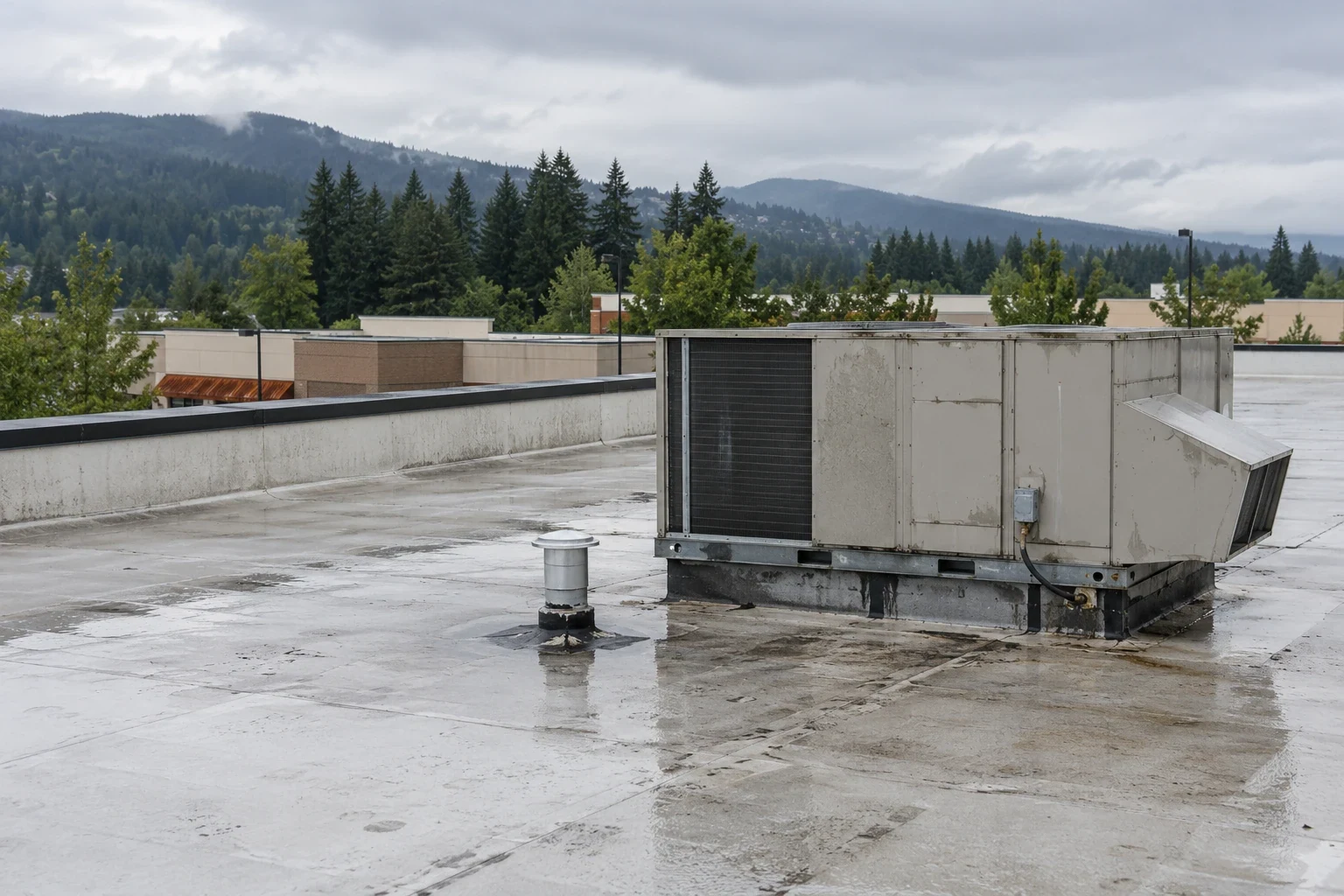
A large, flat roof with few penetrations fails at the details. We walk the seams along their length, the flashing at every wall, the edge metal and each drain. Cores confirm what is under the membrane, and a moisture scan shows whether insulation has taken water. We also check the wall-to-roof transitions at the dock side, since water that enters there lands on staged goods.
Nearby Kent Valley, Auburn and Fife carry warehouse, distribution and aerospace manufacturing buildings, and the roofs there can vary a great deal in age and system. A warehouse roof walk produces a numbered plan with photographs, so an operator running several buildings can compare them directly.
Skylights and smoke vents, where a warehouse has them, are counted and photographed. Each is a curb with a flashing and a lens, and old lenses crack and curbs rust. Rooftop units serving offices or dock areas get the same curb check. Findings are sorted by what they would reach: product, racking, offices or only the roof itself. That ranking tells the operator which items to fix first.
How do we size sections on a very large roof?
A distribution roof can cover a great deal of area, and the tear-off limits are set by what the crew can dry in by evening. On a dry July day that may be a large block. In the wet months it is far less. The limits are marked in paint before work starts, and the crew leader redraws them each morning against the forecast.
Sections run from the low edge upstream, so water already on the roof has a clear path to a drain. The seam between sections is sealed before the crew leaves, and the next day starts with a check of that seal. A recover over dry insulation avoids tear-off, and cores decide whether that is available. Wet insulation forces tear-off and a fuller commercial roof replacement.
Deck condition is checked as the roof opens. Steel decks are checked for rust and loose fasteners, and any area that moves underfoot is marked and priced as a unit. A fastener pull test on the retained deck confirms it will hold the new system. The operator hears about a deck repair the same day, with a photograph and a price.
Where do trucks, trailers and the crane go?
Dock lanes and trailer drops are the constraint. The crane sits where its swing clears dock doors, yard traffic and any overhead lines, and the lay-down yard is placed away from truck turning radii. A spotter is named for each pick, and crane lifts are scheduled for shift changes or quiet hours.
The Port of Tacoma owns more than 2,400 acres used for terminals, warehousing, distribution and manufacturing between the Hylebos and Blair Waterways, and BNSF Railway and Union Pacific serve the port. Fife's economy leans on warehousing and industrial facilities, and freight forwarders gather there because Highway 167, I-5 and the Port of Tacoma all meet nearby. A yard in those areas can be tight, and the staging plan is drawn to fit it.
Trailers and employee parking are the other pressure points. The crew leader names a parking area for the roofing crew that does not take trailer positions or employee stalls, and the delivery schedule avoids shift change. A written note to the gate or the yard manager tells them what to expect each day, so nobody turns a roofing truck away.
How do racking, product and sprinklers stay dry?
Interior protection goes in before the roof opens. Plastic covers racking and product below the work area, and the operations manager moves staged pallets away from the section. Sprinkler lines and lights are protected. A moisture check the morning after rain confirms the ceiling stayed dry.
Rain at Auburn, in the Green River corridor, reaches 37.1 inches in a year, and the gauge climbs fastest in November and December. Tacoma's total is about 40.8 inches over roughly 155 wet days. Because the wet weather stretches from fall into spring, large projects go in the dry months when the operation allows, and winter is kept for repairs and small sections with tested temporary seals.
The forecast drives the day. The crew leader checks it at the start of the shift and again at midday, and the section shrinks if a front moves up. Temporary seals are tested with water and noted in the log. Should the roof have to stay open overnight at a boundary, a taped and ballasted edge covers it, and inspecting that edge is the first job the next morning.
What happens at the dock edge and the roof curbs?
Edge metal, coping and gutters at the dock side take the most abuse, from wind and from trucks. We refasten loose metal, replace bent drip edge and seal the joints. Rooftop units, exhaust fans and skylights get new flashing where the old one has failed, and each curb is tested before the crew leaves.
The 74 mph that the November 2024 bomb cyclone reached at Enumclaw set the high mark for Washington. Edges on a large flat roof catch wind first, so securement belongs in the walkthrough. An edge metal and coping check belongs in a logistics roof plan for that reason.
What does the operator keep at closeout?
At closeout the operations manager joins our crew leader for a pass over every tie-in. In the package are the installed products, layer photographs, product data and warranty terms. It includes a punch list with items closed and the next inspection date. Operators with leased buildings can share the file with the landlord.
Owners with buildings across Kent, Auburn and Fife can keep each file in a multi-site roof program. Investors and manufacturers with similar roofs use the same format.
Insurance and lender requests are common for large buildings, and the closeout file is built to answer them. A dated record of the roof's condition before and after the work, with photographs of the layers, is hard to dispute. The file also helps a tenant who needs to show a landlord that the roof was maintained.
Commercial Roofing Questions
Can roofing happen without blocking dock doors?
Yes. We map the truck lanes and doors first, place the crane and lay-down yard away from them and time lifts for quiet hours.
How do you protect racking and product from a leak?
Plastic goes over racking below the work area, staged pallets are moved and the section is sealed by evening. A morning moisture check confirms the ceiling stayed dry.
What is the best season for a warehouse tear-off?
The dry months, when the operation allows. Winter is for repairs and small sections, with temporary seals proven by a water test.
How big is a section on a large roof?
As big as the crew can dry in by evening. The crew leader redraws the limit each morning against the forecast.
What does an operator with several buildings receive?
One format for every roof: numbered plan, photographs, ranked repair list and closeout package. Buildings can be compared line by line.
Send the roof plan and the dock schedule
Send the roof plan, the dock and shift schedule and any leak reports. We will walk the sequence, staging and tie-ins with your operations team before a number goes on paper.
