
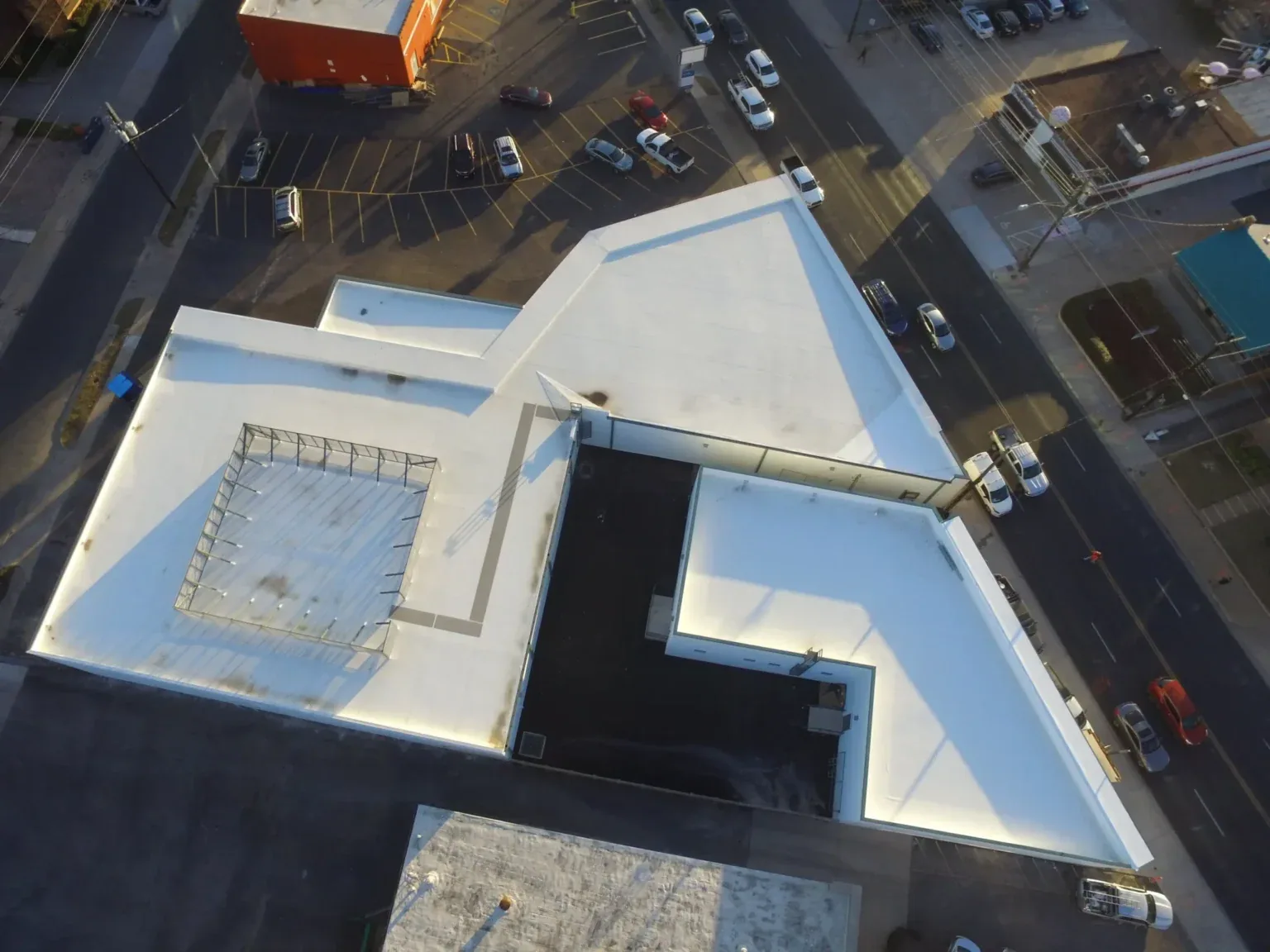
Commercial Roofing Services
Commercial Roof Leak Repair in Federal Way, WA
A leak call in Federal Way, WA begins with the superintendent asking three things: where the water shows inside, what the weather was when it started, and what has been done on the roof lately. The answers shorten the search. Water enters at one point and travels along decking, insulation and ductwork before it drops, so the ceiling tile that stains is rarely under the hole.
We trace the path in order. Interior marks first, then the roof directly above and uphill, then the details that sit along that line. Most leaks end at a flashing, a seam or a penetration, and finding the exact one before cutting anything open saves the owner a larger repair.
How do you find the entry point?
We start inside. A moisture meter on the ceiling and a look at the framing show how far the water has traveled. On the roof, we mark the same footprint and work uphill, because water follows slope and gravity. Every curb, pipe, drain and wall termination along that line is inspected closely.
When the surface does not show a clear defect, we move to tools. An infrared camera at dusk reveals wet insulation, a moisture probe confirms it, and a controlled water test sprays one section at a time while someone watches inside. The test isolates the leak to a few feet. It takes more time than guessing, and it prevents the common outcome of patching the wrong spot three times.
What usually causes the leak?
Most commercial leaks start at transitions, not in the middle of a clean membrane. A curb flashing that has pulled away, a pipe boot cracked by sun and cold, a drain collar that was never sealed, and a seam that opened under thermal movement account for most calls. Punctures from foot traffic and dropped tools account for the rest.
Condition is a cause as well. A membrane that has aged out will leak in many places, and repairs there only buy time. Ponding adds load and speeds aging at seams. We note the cause on the work order and tell you whether the leak is a single event or a sign that the roof system has reached the end of its useful life.
Two causes deserve their own names. An open seam failure lets water run under the membrane, where it can travel a long way before showing inside. A lifted wall termination, handled as flashing failure repair, sends water straight down the wall cavity. In both cases the wet area under the roof is usually larger than the visible damage, so we check the surrounding insulation before closing the repair.
Does the Puget Sound rain change the repair?
It does. Auburn, in the same Green River corridor as the Kent Valley, averages 37.1 inches of precipitation a year, with November at 6.1 inches and December at 5.8 inches, and July the driest at 0.9 inches. A leak that appears in January often has to be controlled before it can be fixed, because adhesives and welds do not take on a damp surface.
Our first move in wet weather is a temporary seal that stops water without hiding the cause: a patch, a sealant bridge or a tarp secured to the curb. A permanent planned repair follows during the next dry window. We tell you which stage we are at so that nobody mistakes a temporary fix for the final one. Wind adds a second concern. The 74 mph that the November 2024 bomb cyclone put on Enumclaw shows how a roof can lose an edge cap or a run of flashing and then leak for weeks before anyone notices. After a windy storm we check the perimeter as well as the stained room.
Who pays for the damage inside?
Water that reaches a tenant space raises questions about responsibility, and documentation answers most of them. We photograph the entry point, the repair and the condition of the surrounding roof. We write down the date, the weather and the cause. Those notes help a property manager explain what happened to a tenant and help an insurer understand the loss.
If the leak came from a storm, the file supports a claim, and our roof insurance claim assistance can organize the evidence. If the leak came from long-term wear, the same file shows the owner what has to be fixed to prevent a repeat. We also tell you which interior materials are likely wet so a restoration contractor can respond.
Which Federal Way buildings leak differently?
Different roofs leak in different places. A strip center on Pacific Highway South in Federal Way City Center has rooftop units and tenant penetrations, so those curbs get checked first. On the industrial buildings Industrial Realty Group is developing in the Woodbridge area of the former Weyerhaeuser campus, any skylight, vent or fan frame on the roof needs careful sealing around its edges.
Hospital and school roofs bring tight access rules. A healthcare building near St. Francis Hospital may need the work done with odor controls and quiet hours. A school roof must be repaired outside class time. We ask about access, hours and tenant sensitivity before the crew arrives, so the leak is stopped without creating a second problem inside.
What happens after the leak stops?
We close the call with a short report. It states the entry point, the cause, the repair, the photos and what else we saw on the roof. If we found other weak spots, they go on a priority list with prices, and none of them are done unless you approve them.
A leak is also a prompt to check the whole roof. A commercial roof inspection can reveal other open seams and tired flashing before they leak. For roofs with repeated leaks, an infrared moisture survey maps the wet insulation so you can decide between repair and replacement with data.
Commercial Roofing Questions
Why does the leak stain not sit under the hole in the roof?
Water travels along the deck, between insulation boards and down conduit or ductwork before it finds a gap to drip through. The stain can be thirty feet from the entry point. We follow the slope uphill from the stain and check every detail along the line.
Can you fix a leak during a rainstorm?
We can stop it for the moment with a temporary seal, a patch or a tarp. A durable repair needs a dry surface, so it waits for a window. We tell you at the end of the visit which kind of repair you have and when the permanent work will happen.
How do I know whether a leak means the roof is finished?
One leak at a failed boot is a repair. Leaks in several places, wet insulation across a large area, or repeated failures at seams suggest a system near the end of its life. Core cuts and a moisture scan sort the two, and we give you the numbers for each option.
Should I call my tenant's insurance or mine?
Your lease and policy decide that, and the roof documentation helps whichever route you take. We supply dated photos, the cause and the repair record, and we leave coverage decisions to the insurer.
What can the facility team do while waiting for the crew?
Move sensitive items, put out containers and photograph the stain and the ceiling. Keep people clear of sagging ceiling tiles, which can hold a lot of water. Call us with the location and the time the leak began, and we will begin the search the same way.
Describe the leak and the building
Tell us where the water shows, when it started and what the weather was. We will start the trace the same day and report the entry point and the repair.
