
Commercial Roofing Services
Roof Recover and Overlay in Federal Way, WA
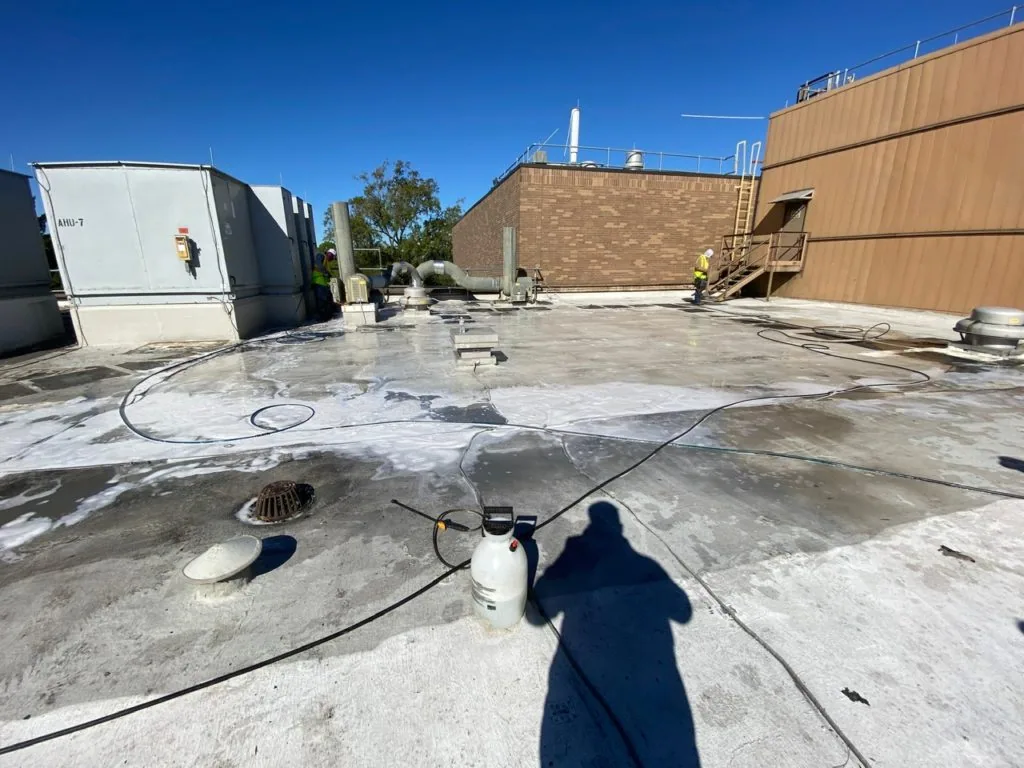
Marking a recover starts with a question the superintendent asks of the old roof: is it dry enough to carry another layer? He answers it with core cuts, a moisture scan and a look at the deck from below. A recover leaves the existing membrane in place, adds a cover board or new insulation over it, and puts a fresh membrane on top. It saves tear-off labor and disposal, and it keeps the building protected the whole time.
It is not the right move for each roof in Federal Way, WA. It works when the old system is dry, flat enough, and light enough for the deck to carry. It fails when a roof that should have been torn off gets buried under a new layer that traps moisture. Sorting those two cases is the first job on site.
Is the old roof dry enough to keep?
We cut a core every few thousand square feet across the field, with extra cores near drains, curbs and low spots. Each core shows the layers, the insulation condition and any moisture at the deck. An infrared moisture survey at dusk, when wet insulation holds its heat longest, shows the pattern across the whole roof. We mark the wet zones on a plan and measure them against the total.
If wet insulation is limited, we cut it out and replace it before the overlay goes down. If it covers a large share of the roof, the recover is off the table, and we recommend a full replacement instead. Auburn, which shares the Green River corridor with the Kent Valley, takes about 37.1 inches of precipitation a year, and insulation that has soaked up years of that rain will not dry out beneath a new membrane.
What do code and the deck allow?
Under Washington's amendments to the 2021 International Building Code, and the 2021 IECC for commercial energy, the rules are set at the state level. Code limits how many roof layers a building may carry. Most jurisdictions permit one recover over a single existing roof system and require a tear-off after that. We confirm the layer count before we write the scope, and we confirm with the plan reviewer when a case is unclear.
The deck has to carry the added weight, and it has to hold fasteners. A steel deck with surface rust may be fine for adhered systems and poor for mechanically attached ones. A wood deck that has been wet needs probing for soft spots. We report what we find and match the system to the deck, not the other way around. Insulation levels also matter, because a recover may trigger energy code upgrades if the work goes beyond a repair.
What goes between old and new?
The usual build is a cover board or a layer of rigid insulation fastened or adhered over the existing membrane. That layer separates the old surface from the new one, spreads loads, and gives the new membrane a uniform base. Over a gravel built-up roof, a cover board also helps cap the stone. Over a smooth membrane, a primer and adhesive may be enough.
The new surface is typically a single-ply such as TPO or EPDM, or a fluid-applied coating on a roof that qualifies. We choose by the existing substrate, the roof traffic and the fire rating the building needs. Each layer is listed on the scope sheet with a price beside each, and how it changes the roof's drainage and parapet heights.
How do we protect flashings and drains?
Adding thickness raises the roof surface, and every raised inch cuts into the flashing height at walls, curbs and penetrations. Base flashing normally needs a minimum rise above the roof surface. If the recover reduces that rise, we extend the flashings, raise the curb or reset the equipment. That work belongs in the bid from day one.
Drains are the other risk. A thicker roof sits closer to the drain bowl. We raise or replace drain bodies and add tapered crickets so water keeps moving to the drain. On a warehouse with a long run to its interior drains, the kind common in Fife, we check the slope across the whole length before we choose the cover board. A recover that creates ponding at the drains has failed its main job.
What does the schedule look like?
A recover usually goes faster than a tear-off because there is less debris and less open roof. The crew prepares the surface, repairs wet insulation, lays the cover board and installs the membrane in sections. Each section is dried in the same day, and a small leak gets a planned repair before the overlay covers it. Because the old roof stays in place, the building has two layers of protection during the work.
That helps when the roof sits above a tenant that cannot tolerate noise or odor. A retail tenant in Federal Way City Center or an office in Burien, near the SR 509 and SR 518 junction, can keep operating while the crew works above. We still schedule loud tasks, such as fastener drilling, for the quietest hours and sleeves on the equipment that vibrates the most.
When should you walk away from a recover?
We walk away from a recover when the numbers do not support it. A roof with widespread wet insulation, a deck with active corrosion, a second recover on a roof that already carries two layers, or a building that cannot tolerate additional dead load all point to a tear-off. We show the evidence so the decision is shared.
A tear-off costs more on day one, but a recover over a wet roof costs more in the long run because the new warranty rests on a failing base. When we advise against a recover, we explain which core or scan shows the problem. When the old roof qualifies, the savings are real, and we put them on paper beside the replacement price.
Commercial Roofing Questions
How many layers can my Federal Way roof carry before code requires a tear-off?
In most cases one recover over a single existing system is the limit, though the adopted code and the way the roof is built set the final answer. We check the layer count by cutting a core and confirm the requirement with the plan reviewer before pricing the job. If the roof already has two layers, a tear-off is the plan.
Does a recover change the roof warranty?
It can. Manufacturers set conditions for installing over an existing roof, including a dry substrate and an approved cover board. We build the system to the manufacturer's recover specification and submit the required documentation, so the warranty terms reflect what was actually installed.
Will the added layer overload the deck on a warehouse in Auburn or Kent?
Warehouse roofs differ in deck type and in what they already carry, so we read the structural drawings where they exist, check the deck in person and weigh the added cover board and membrane against what the drawings allow.
What happens to wet insulation we find during the work?
We cut it out to the edge of the wet area and replace it with new insulation matched to the thickness around it. The repair is photographed and logged, and we price it at a unit rate set before work began. This keeps a small surprise from turning into a delay.
Is a coating better than a recover with a new membrane?
A coating suits a roof that is sound, dry and clean, and it is a lighter-duty answer than a membrane recover. If the roof has seam failures, patches and open flashing, a membrane gives more coverage. We compare both on the same roof plan and show the cost difference.
Send the roof plan for a recover check
Send the roof plan, the age of the existing system and the number of layers you know about. We will schedule cores and a moisture scan so the recover decision rests on what is in the roof.
