
Roof Systems
KEE Roofing in Federal Way, WA
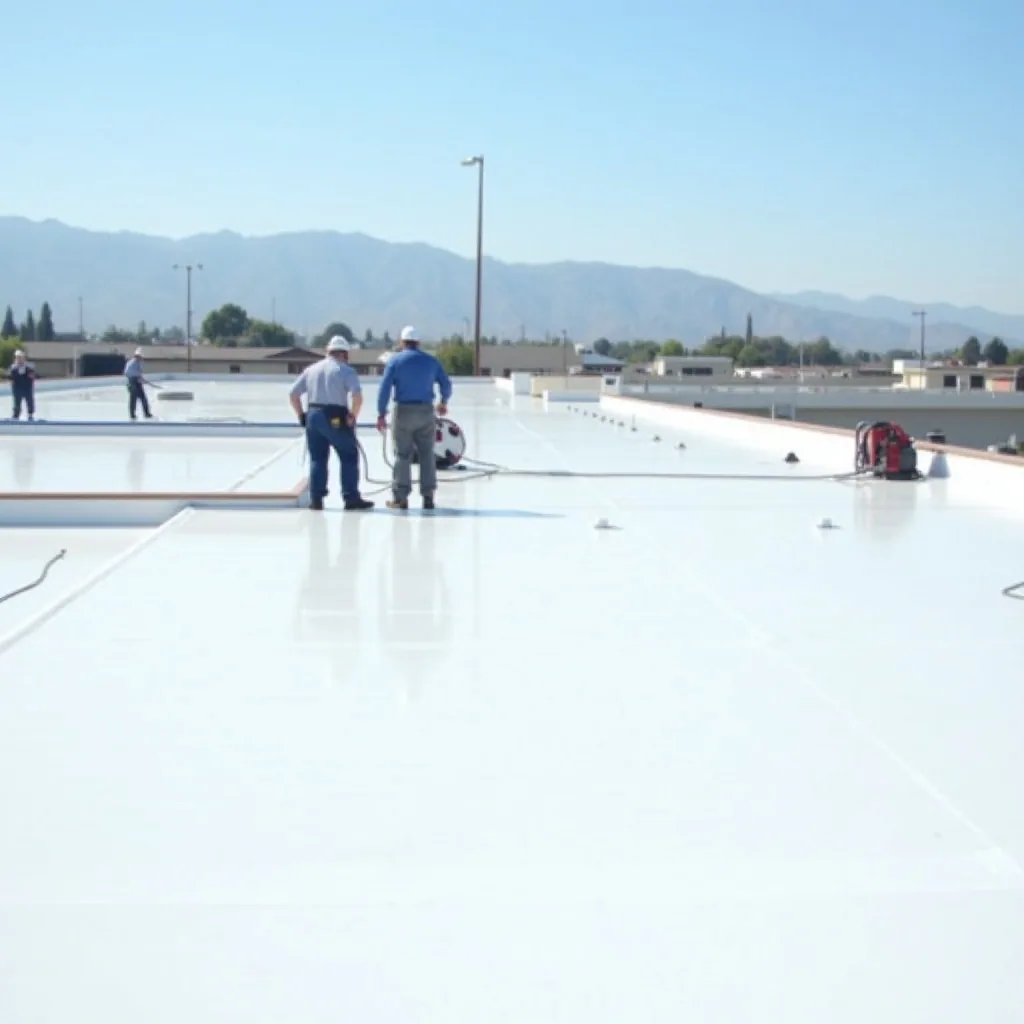
On a KEE roof, the superintendent walks the vents before the field. KEE membranes, a PVC alloy blended with a ketone ethylene ester, are chosen for roofs that take heavy grease, oil or chemical discharge, and the vents show how heavy that discharge is. A fryer exhaust, a lab hood or a process stack can put out enough vapor to coat the roof within feet. Where that happens on a Federal Way, WA building, the roof choice is no longer about price per square foot. It is about whether the sheet will still be flexible years from now.
The rest follows the usual order. Cores and a moisture scan decide what stays, tear-off limits are painted on the deck, and the crew lifts, strips, insulates and covers in sections that are dried in before the shift ends.
What does the alloy add to a PVC sheet?
Standard PVC uses plasticizers to stay flexible, and some of those plasticizers can leach out over time, especially under heat or contact with fats. A KEE alloy holds its flexibility better in those conditions, which slows stiffening and cracking near vents. The sheet is still a reinforced thermoplastic, welded at the seams, and it is installed the way a PVC roof is.
The difference shows up in service. A standard PVC sheet near a heavy exhaust may stain, stiffen and crack at flashings sooner than the same sheet away from it. A KEE sheet near the same exhaust ages more slowly, while an EPDM roof would swell under the same oils and is a poor match. Whether that is worth the added material cost depends on the discharge, the roof area exposed and the building's planned life. We put those facts next to a price for each membrane so the owner decides on numbers.
Thickness is the other lever. A thicker sheet carries more material for the weather and for foot traffic to wear through. Reinforcement, usually polyester or glass fabric, adds strength across the sheet and holds welded seams together under load. We read the manufacturer's data for each product we propose and list thickness, reinforcement and attachment on the scope so two bids can be compared line by line.
When is the premium worth paying?
Three tests help, and each one can be answered on the first walk. First, how often does the vent run, and what does it discharge? A kitchen that fries all day is a heavy user. A laundry that vents steam is lighter. Second, how much of the roof sits within the discharge zone? Often it is a small area, and a KEE patch of field sheet around the vent, with standard membrane elsewhere, can be a lower-cost answer. Third, how long will the building keep its use? A short hold favors the cheaper sheet.
We map every vent on the plan, mark the discharge zone and ask the mechanical contractor what comes out. If one zone is heavy and the rest is clean, we price a mixed roof. If most of the roof is exposed, we price a full KEE roof. The restaurant roof and the hospital roof are the usual cases. Where grease is the issue, we also look at grease containment on the exhaust itself, since keeping discharge off the roof helps any membrane. A fan with a failed containment tray can undo a good roof quickly, and a short note to the building engineer often costs less than the first repair.
How do we weld and detail a KEE sheet?
Seams are fused with hot air after the laps are cleaned. Grease-laden surfaces will not weld, so the crew degreases the lap, wipes it dry and runs a test weld each morning. A sample that peels cleanly at the interface tells the crew leader to adjust the machine before the field work starts. Seams are probed along their full length once cooled.
Details around vents and curbs get the most care. Prefabricated boots and corners are welded to the field sheet, and curb flashings turn up high enough to clear the discharge. Where a vent throws grease onto the sheet, we add a splash pad or a deflector. Pads wear out, so we list them for replacement on a schedule. At the closeout walk, your superintendent and ours go over each vent, curb and drain one tie-in at a time, with photographs for the record. Anything left open goes on the day-one punch list with a date, and the crew leader signs off each item when it is closed.
How does the wet season affect the job?
In Tacoma about 40.8 inches fall over roughly 155 wet days, and in Auburn 37.1 inches, wettest in November and December. A damp lap will not weld, and a wet roof holds grease in a film that makes cleaning harder. So KEE work is booked for the dry stretch where possible, and outside that stretch each day's opening is held to what can be sealed by evening.
Edges and corners are fastened for the kind of wind Enumclaw saw in the November 2024 bomb cyclone, 74 mph, the highest of any Washington community. The amended 2021 International Building Code and the 2021 IECC, which Washington uses for commercial buildings, fix insulation levels and curb heights in the scope. The sequence is the same for a commercial roof replacement or a recover over dry insulation. Between jobs, the vent map and the discharge photographs stay in the roof file, so the next crew knows which zones were treated as heavy.
Where do KEE roofs make sense locally?
Healthcare buildings come first: a hospital roof can carry kitchen exhaust, laundry vents and lab hoods in a single plan, and Federal Way has St. Francis Hospital and the Virginia Mason medical center. Food-service buildings along Pacific Highway South raise the same question wherever kitchens exhaust to the roof.
Industrial buildings with process exhaust, including any of the warehouse, distribution and aerospace manufacturing buildings in the Kent Valley, Auburn and Fife, are the third group. In each, the roof is judged by what lands on it. A hospital kitchen and laundry often share a roof with air-handling gear, so the vent map is the first drawing made. An owner in Federal Way City Center or Kent can send the roof plan and the vent list, and no number goes out until both superintendents have walked the sequence, staging and tie-ins.
Commercial Roofing Questions
Is KEE a different material from PVC?
It is a PVC alloy. The membrane is built on PVC and blended with a ketone ethylene ester for better resistance to fats and chemicals. It is installed and welded in a similar way.
Can I mix KEE near the vents with a different membrane elsewhere?
Often, if the membranes are compatible and the seams are detailed correctly. We cover the discharge zone with KEE and use standard sheet elsewhere, with a welded transition. We confirm compatibility with the manufacturer's literature.
How do I know how heavy my exhaust is?
Ask the mechanical contractor or the kitchen operator, and look at the roof. Greasy staining, dark films and a sticky surface near a vent are signs of heavy discharge. We photograph and record the pattern.
Does a grease trap on the exhaust help the roof?
Yes. Capturing grease at the source keeps it off the membrane. We recommend checking the containment system alongside the roof.
What does maintenance involve?
A yearly walk, cleaning near vents, checking splash pads and probing seams and flashings. We log it and compare photographs year to year.
Send the roof plan and the vent list
Send the roof plan, the list of vents and what they discharge, and the project schedule so we can walk the sequence, staging and tie-ins with your superintendent before a number goes on paper.