Commercial Roofing Services
Solar-Ready Roofing in Federal Way, WA
Before a solar crew sets a single rack on a Federal Way, WA roof, our superintendent walks the deck with the roof plan and asks how many years the membrane has left. An array can outlast the roof under it, and then the owner pays to lift it, replace the roof and set it back. The cheapest time to settle the roof is before the first mount goes down.
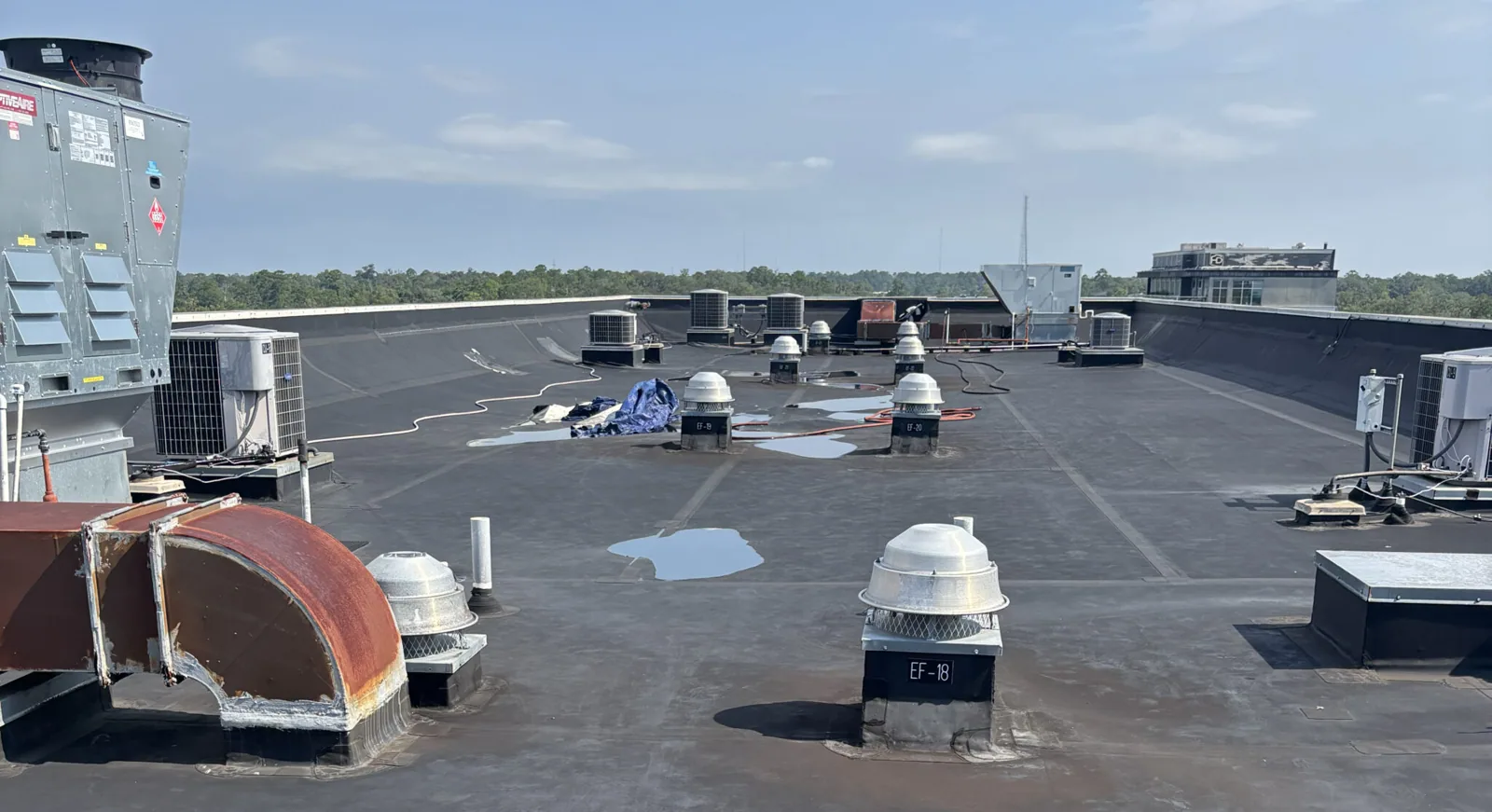
The walk covers the same ground as any roof check: core cuts, a moisture scan, a look at flashings and drains, and a count of the penetrations already on the surface. Then we mark where racks, walkways and access paths will sit, so the roof we hand the solar contractor is dry, flat enough and drawn on paper. A crew leader stays on the job through the handoff, because the first week after racks go up is when a missed flashing shows itself in the first heavy rain.
Is the roof ready for an array?
Readiness has three parts: the membrane, the insulation and the structure. The membrane needs enough service life to justify the array. Cores show whether the insulation under it is dry, because wet board under a rack hides a leak that cannot be reached without removing panels. The structure has to carry the added load, and that is a question for the engineer or the original drawings, not for a guess. We pass what we find, such as deck type and condition, to the engineer so the answer rests on the roof as it stands.
If the roof is near the end of its life, the better order is roof first, array second. A new TPO roof or PVC roof goes on, the penetrations are flashed to the final layout, and the solar contractor sets the array on a fresh surface. Where the roof is sound and has years left, we repair what is open, record the layout and leave it alone. In both cases, the plan is written down so the next trade starts from the same facts.
How do mounts meet the membrane?
Arrays attach in three common ways. Some racks are ballasted, with weight holding them down and no penetrations. Some are mechanically attached through the membrane to the deck, with a flashed boot at each post. Others are adhered or clamped to metal seams. Each has its own roof risk. Ballast concentrates load and can abrade the membrane. Through-roof posts add holes. Seam clamps depend on the seam being sound.
We specify protection pads under ballast, prefabricated or formed boots at posts, and a compatible detail at each attachment, with posts kept off seams and clear of drains and walk routes. Every flashing is photographed before it is covered, because a mount flashing is not reachable after the panels are in. The photographs go in the closeout set with the post locations marked on the plan, so a leak report a year later can be matched to a specific mount in minutes. We hold a pull test on fasteners where the deck allows, and we log the result. The penetration flashing standard we use for pipes applies to posts as well.
What does wind do to an array and its edges?
In November 2024 a bomb cyclone drove 74 mph winds across Enumclaw, the highest reading of any Washington community. Even without a storm that size, wind lifts at roof edges and corners, and an array changes how air moves across the surface. Racks and panels also catch wind, and the load passes into the roof through ballast or posts.
The roof's edge securement belongs in the walkthrough before the array is designed. We check edge metal, coping and the membrane termination, and we fasten them as if that November wind is coming back. The solar designer sets the array's own wind limits and setbacks, and our job is to hand over an edge that will hold. Where ballast is the plan, we confirm the roof can carry it and that drains stay clear. A wind-damaged roof under an array is a hard repair, so the edges are cheaper to fix first. Edge work done now also gives the solar designer a known, documented perimeter to calculate against.
How do we reroof around or under an existing array?
Sometimes the array is already up and the roof needs work. The sequence is the same as any tie-in job, only with more trades. The solar contractor disconnects and lifts panels in sections, we tear off and replace the membrane beneath, and the racks go back on flashed mounts. Each section is dried in the same day. We plan the sections with the solar contractor so that disconnects, crane time and weather do not collide.
When the array stays, the work is limited to what can be done around it: repairs at drains, flashings and seams, with walk paths protected. We keep clearances so water drains past the racks. Auburn's 37.1 inches a year, wettest in November and December, and Tacoma's 40.8 inches over roughly 155 wet days make a clogged drain between rows a risk we treat seriously. A commercial roof repair near an array is scheduled for a dry window.
Which buildings are the common candidates?
Large flat roofs are the usual candidates: warehouses and distribution buildings in the Kent Valley, Auburn and Fife, and new industrial buildings such as those in the Woodbridge park on part of the former Weyerhaeuser campus. Retail buildings on Pacific Highway South and at The Commons are further candidates, though rooftop units take space. Each building has its own layout, and we map it before the first layout meeting. The map shows drains, curbs, skylights, parapets and any existing mounts, with distances noted, so the designer starts from measured space instead of the original drawings, which may no longer match the roof.
Fire access and layout rules under Washington's amended 2021 building code and the 2021 commercial energy code may shape the array, which brings the plan reviewer into the conversation. Owners in Kent and Fife send the roof plan and the solar schedule, and the superintendents then walk the sequence, staging and tie-ins together.
Commercial Roofing Questions
Should the roof be replaced before solar goes on?
If the roof has fewer years left than the array is meant to run, yes. Doing the roof first avoids lifting and resetting panels later. If the roof is sound with many years left, repair what is open and leave it. Cores and a moisture scan settle the question.
Does ballast hurt a membrane?
It can. Weight concentrates at the racks and abrades the surface where it moves. We place protection pads under ballast, check the roof's capacity and inspect the contact points on a schedule.
Who flashes the mounts?
The contract decides, and we recommend the roofing trade flash every through-roof mount, because the roofer owns the waterproofing and its records. We coordinate with the solar contractor on locations and timing.
What happens to the warranty?
Manufacturers attach conditions to work on and around a roof, solar included. We read the terms before design, build to them and keep the records, and the manufacturer decides coverage.
How long does an array removal and reset take?
Array size and weather set the duration. We schedule it by section, with the solar contractor lifting and resetting while we replace the membrane, so no more roof is open than can be dried in by evening.
Send the roof plan and the solar layout
Send the roof plan and the project schedule, along with the array layout if you have one, so we can walk the sequence, staging and tie-ins with your superintendent before a number goes on paper.