Commercial Roofing Services
Roof Insulation, Tapered Systems and Cover Board in Federal Way, WA
The core cut tells the story before a board is ordered. The superintendent opens the roof at a few spots, measures the insulation thickness, checks whether it is dry, and notes what sits under it: steel deck, concrete, wood. Those numbers decide how much insulation goes back, what kind, and how it is attached.
On a low-slope commercial roof in Federal Way, WA, insulation does three jobs. It slows heat loss and gain, it gives the membrane a flat and firm base, and, when it is tapered, it carries water to the drains. Cover board adds a fourth: a hard, thin layer between insulation and membrane that protects both from foot traffic, hail, fastener plates and moisture. Choosing these layers well is how a roof meets code and lasts through the wet season.
How much insulation does the code require?
The state commercial energy code, built on the 2021 International Energy Conservation Code for commercial buildings (Chapter 51-11C WAC), sets minimum insulation values for roofs. A reroof or a replacement that exposes the deck generally has to bring the roof assembly up to the required value, though exceptions exist for some recovers and repairs.
We confirm the requirement for each building with the plan reviewer before pricing, because it depends on the scope of work, the roof assembly and the use of the building. Most commercial assemblies use rigid polyisocyanurate board, installed in two staggered layers so the joints do not line up. Staggering the layers reduces heat loss through the seams and makes a flatter surface.
Thermal values drop with age and with moisture. Existing board that has been wet, crushed or compressed gives less insulation than its original thickness suggests. A moisture survey and core results tell us how much of the old board is worth keeping, and the infrared moisture survey maps wet areas so only the damaged sections are replaced.
Where does tapered insulation belong?
Tapered insulation is cut in wedges that make a slope across a flat roof. Panels are numbered and laid to a drawing, with the thin edge at the high point and the thick edge at the drain. A flat roof that ponds water usually needs slope more than it needs a new membrane, and a taper is the most direct way to add it.
Crickets are small tapered pieces set behind curbs, units and parapets, so water goes around the obstruction instead of stopping against it. A roof with many curbs may need a dozen. The taper plan must account for the finished height at doors, parapets and curbs, because adding thickness can shorten a flashing below its minimum.
The Kent Valley and Fife carry warehouse buildings with large, simple warehouse roofs where a taper can be laid in long runs. A retail roof, such as those along Pacific Highway South, often has smaller sections, so the plan is closer to a patchwork of crickets and slope pieces. Tapered work ties directly into drain and scupper correction, since a low drain location is often fixed by changing the slope around it.
Why add a cover board over the insulation?
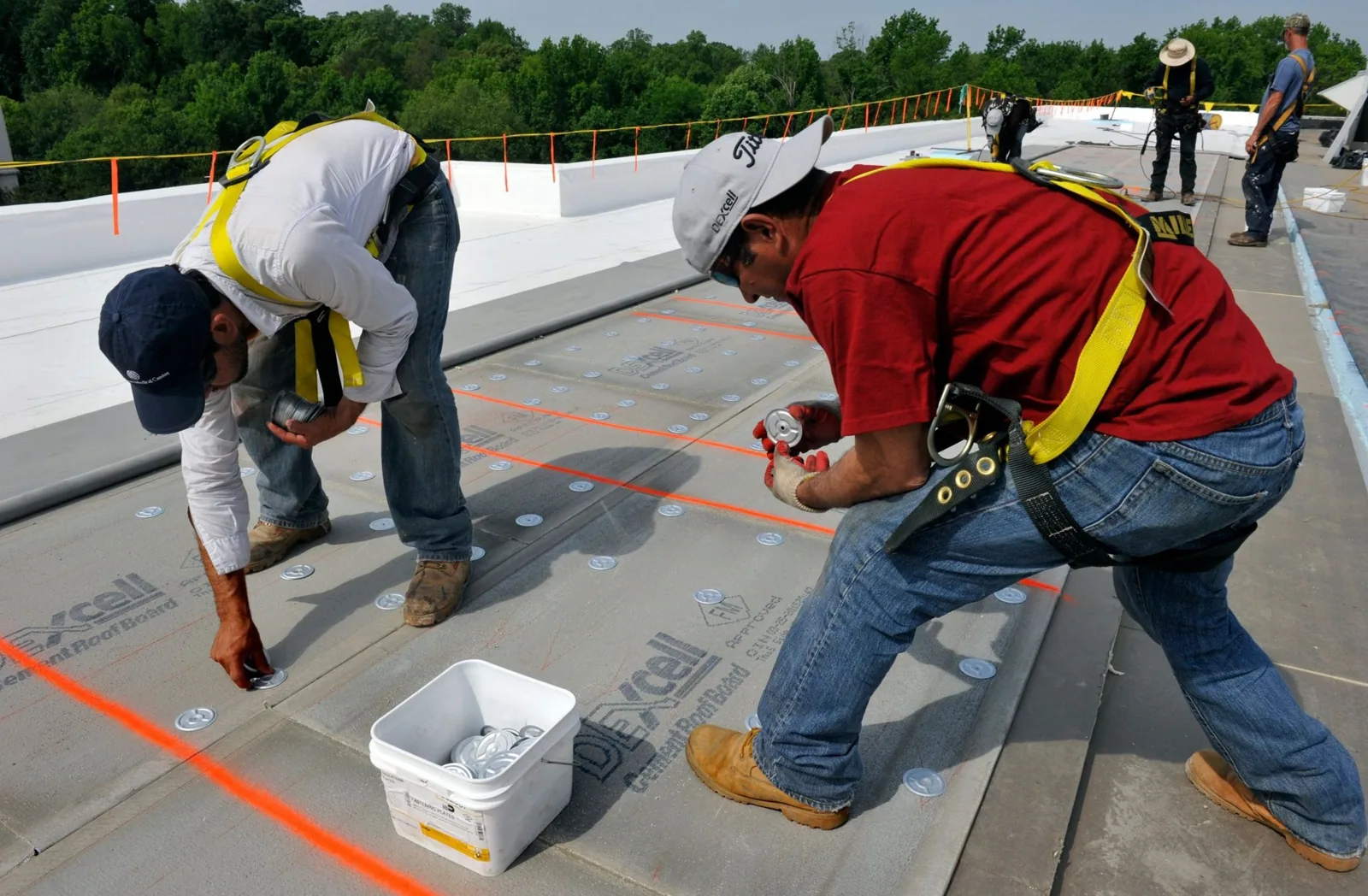
A cover board is a thin, dense panel, such as gypsum, high-density polyiso or fiber board, laid between the insulation and the membrane. Foam insulation is soft. Foot traffic, rooftop service and dropped tools can dent it, and hail can fracture a thin membrane over it. A cover board spreads the load and gives the membrane something solid to bear against.
It also helps with moisture. Some cover boards resist water better than the facer on the insulation, so a small leak does not soak the board below. In a wet climate, where the roof sits damp from October through March, that margin matters. Cover board also separates the membrane from chemical incompatibility between the insulation and certain adhesives or membranes.
Attachment depends on the system. Cover boards can be adhered with low-rise foam, set in hot asphalt, or mechanically fastened with plates. We follow the membrane manufacturer's pattern and the wind uplift rating for the site, and we keep the attachment schedule in the roof file.
What changes in a recover or a partial replacement?
In a roof recover, new insulation or cover board goes over the existing membrane. That adds weight and height. We check the deck's capacity, the code limit on the number of layers and the flashing heights before committing. If existing insulation is wet, it comes out first.
In a partial replacement, a new section must tie into an old one. The old insulation thickness sets the height, so the new section is built to match or tapered down to it, and the joint is flashed so water cannot run under the edge. We note every transition on a drawing so the crew sets each one the same way.
Roofs on hospitals and other occupied buildings carry another consideration: noise and odor from adhesives and torches. Low-odor foam adhesives and mechanical attachment let work proceed near air intakes and sensitive areas.
What decisions does the owner need to make?
Three choices drive the price. The first is thickness, set by code and the owner's energy goals. The second is whether to add taper, which depends on drainage and the budget for fixing slope. The third is the cover board, which depends on traffic, hail exposure and the membrane. We price each as an option so the owner sees the cost of every layer and what it buys.
Timing also matters. Insulation and cover board must stay dry, so staging matters in the October to March rains. Each day's opening is limited to what can be covered and sealed by evening, and unopened board is stored under cover in the lay-down yard.
Commercial Roofing Questions
Does tapered insulation add enough slope to fix ponding on an older warehouse roof?
Usually yes, if the deck can be reached and the flashing heights allow for the added thickness. We survey elevations, draw the taper layout and check each curb, door and parapet for clearance. Where a wedge cannot fit, we recommend a new drain or a relocated outlet instead.
Can the old insulation stay under a new membrane?
Only if it is dry, firmly attached and still thick enough to be worth keeping. A core cut and moisture scan decide this. Wet board is removed, and compressed or crumbling board is replaced. Leaving bad insulation in place shortens the life of the new roof.
Is cover board required by the membrane manufacturer?
The system decides. Some manufacturers require a cover board for specific warranties or for certain attachment methods, and others treat it as an option. We follow the published requirements for the system on your roof and tell you where an upgrade is a good idea even when it is not required.
How does insulation affect hail and wind performance?
The assembly as a whole is rated, and insulation and cover board are part of it. Denser, firmer boards resist impact better, and the attachment pattern determines uplift resistance at the edges. The November 2024 windstorm that reached 74 mph in Enumclaw is a reminder to rate the attachment for the site and not just the product.
What is the cost difference between a single and a double layer of insulation?
A second layer costs more in material and labor, but it improves thermal performance and covers the joints in the first layer. Where code requires a high total thickness, two layers are common. We price both and show the energy difference so the owner can compare.
Send the roof plan and the core results
Send the roof plan, the existing assembly if you know it and any drainage concerns. We will cut cores, measure the insulation and walk the taper and cover board plan with your superintendent before we price it.