
Service Areas
Commercial Roofing in University Place, WA
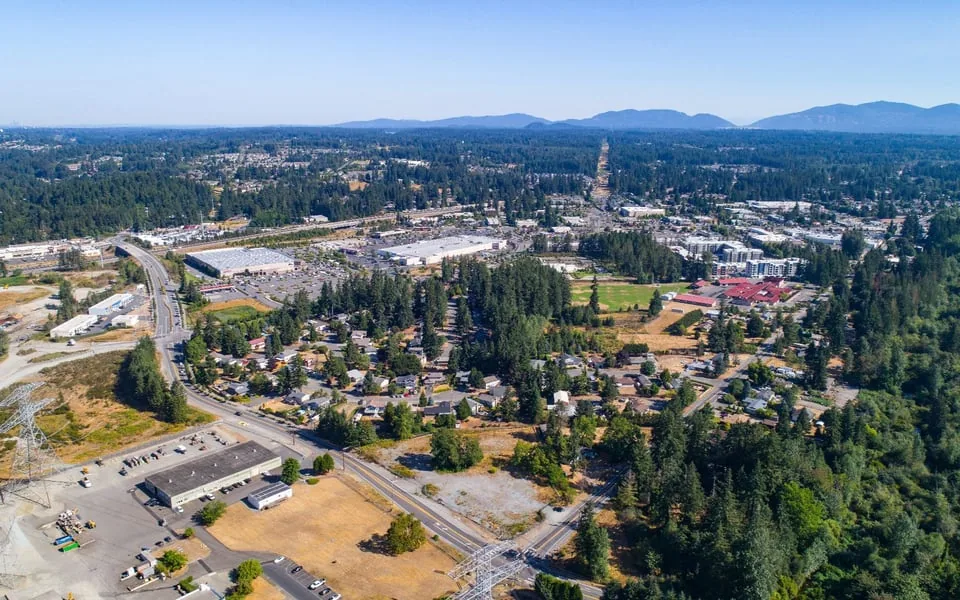
Before a crane pick is scheduled on a University Place building, the superintendent walks the roof and looks at how it meets the walls, because a mixed business and residential city puts shops, offices and homes under flat roofs that were never all built the same way. University Place sits on Puget Sound in Pierce County, covers 8.51 square miles at 417 feet elevation and had 34,866 residents in 2020. Commercial roofs here answer to two audiences at once: the owner who pays for the work and the neighbors who live next to it.
We reach the city from Federal Way, WA, and we plan every job from the deck up.
What does the first walk look for?
We start at the hatch or ladder and read the roof in the order water leaves it: drains, scuppers and gutters first, then parapets and walls, then curbs and penetrations, and last the field of the membrane. A blocked outlet explains half of what shows up elsewhere, so it is cleared before anything else is judged.
Core cuts follow at soft spots and at points the plan picks in advance. They show the number of layers, whether insulation is wet and how the substrate board is holding. A fastener pull test on the deck tells us whether a recover is realistic. Findings go on a marked-up plan with photographs, and the day-one list ranks what is urgent and what can wait for the dry months.
How does a mixed business and residential city change the job?
When commercial space sits near homes, the roofing crew shares its lay-down yard, noise and truck routes with neighbors who did not hire it. We plan the staging area to keep trucks off residential streets where we can, set start times that respect the neighborhood and name a crew leader whom the property manager can call with a question.
Inside a mixed building, offices or apartments may sit directly beneath the roof. The occupied building reroofing sequence keeps each opening small, seals it the same day and protects the interior below. Roof access is by hatch, ladder or exterior stair, so the route is walked before bundles go up, and the crew leader confirms which before the first delivery so no one is hauling bundles through a tenant's suite. Residents get a written notice with the dates and the noisiest steps, and the notice says who to call about a ceiling stain.
Chambers Bay opened in 2007 and hosted the 2015 U.S. Open. Near a venue like that, streets and lots can fill on event days, so we ask the property manager for any known dates, keep crane picks and deliveries off them and hold the lay-down yard to a footprint that leaves customer parking intact.
What does the Sound mean for a roof?
University Place lies on Puget Sound, and a roof near saltwater gets a closer look at metal. We check fastener heads, edge metal, cleats and rooftop unit housings for corrosion, and we choose fasteners and fascia components with a coating that suits the exposure. Metal flashing is checked for pitting, and any piece that flakes under a screwdriver is replaced instead of sealed over. Wind is part of the same walk, because a shoreline exposure is one more reason to check the perimeter.
Edge securement is a standing item on every shoreline roof, with the November 2024 bomb cyclone's 74 mph at Enumclaw, the highest in Washington, as the reference. Perimeter metal is pull-tested, corner zones are fastened more tightly, and any loose piece is replaced before the crew leaves. The details for a wind-damaged roof start at the same corners.
How does the wet season shape the schedule?
Rain is steady around University Place: Tacoma has roughly 155 wet days a year, and Auburn peaks in November and December. Federal Way, the starting point for our crews, has no monthly average above 71.6 F, so heat seldom limits the schedule. The rain pattern makes the dry months valuable. When the owner can wait, a large tear-off goes into the dry stretch, with materials ordered early enough that a late delivery cannot push the job into October. In the wet months the opening shrinks to the section the crew can strip, insulate, cover and seal before dark, with a temporary seal waiting along the edge.
Which roof systems fit a University Place building?
The choice follows the building and the owner's plan. A TPO roof suits a reflective, welded-seam membrane over a well-drained deck. A modified bitumen or built-up roof makes sense where foot traffic and many penetrations call for layered redundancy. A standing seam metal roof fits where slope and long life matter most. A coating can extend a sound roof without tear-off.
When drains and ponding are part of the problem, drain and scupper work is priced as its own item. Core cuts, a moisture survey and drainage findings decide whether the roof is a repair, a recover or a replacement candidate. The owner then sees each option with photographs and the cost drivers: roof area, access, wet insulation, number of units to lift and the number of phases the occupants accept.
What happens at closeout?
The closeout walk covers every tie-in, curb and edge with your superintendent. You receive the marked roof plan, photographs, product data and a list of anything left for another visit, each item with a named trade. Warranty terms are the manufacturer's, and the paperwork is assembled to meet them.
Owners with property in the neighboring cities receive the same package for each roof. Work in Fircrest and Tacoma uses the same format, so a manager can line up the condition of roofs across the area and put the weakest on the calendar first.
Commercial Roofing Questions
Can a roof above apartments and shops be replaced without moving anyone out?
Yes, when the work is cut into small sections and each one is sealed before the crew leaves. Residents and shop tenants get written notice of dates and noisy steps, interiors are protected below each opening, and one crew leader takes questions.
Does being on Puget Sound change the fasteners and edge metal we choose?
It changes how closely we inspect them. We look for corrosion at fastener heads, cleats and unit housings, and we specify coated or corrosion-resistant components where the exposure calls for it. Edge metal is pull-tested at corners because wind and salt both attack there.
What is the cheapest way to extend a sound roof a few more years?
A coating over a dry, well-bonded substrate, after repairs to seams and flashing and a moisture survey to confirm the insulation is dry. A coating over wet insulation fails early, so the survey comes first and the coating scope follows its results. Repairs to ponding areas, open laps and failed flashing are done before the coating goes on, since a coating hides a defect without fixing it.
When should we order materials for a summer tear-off?
Early spring at the latest, once the scope is set. Delivery lead times, crane availability and any special order flashing all need weeks, and a late delivery pushes the tear-off into the wetter months. The schedule lists each order date beside the work it supports.
Who is our contact while the crew is on the roof?
The crew leader. Their name and number go on the tenant and resident notice, and they walk the roof when work opens and again when it closes each day. Complaints and ceiling stains go to that person, who reports to the project superintendent.
Send the roof plan and the occupancy schedule
Send the roof plan, the tenant or resident schedule and the hours the crane can swing. We will walk the sequence, staging and tie-ins with your superintendent before a number goes on paper.