Commercial Roofing Services
Roof Drains, Scuppers and Ponding Correction in Federal Way, WA
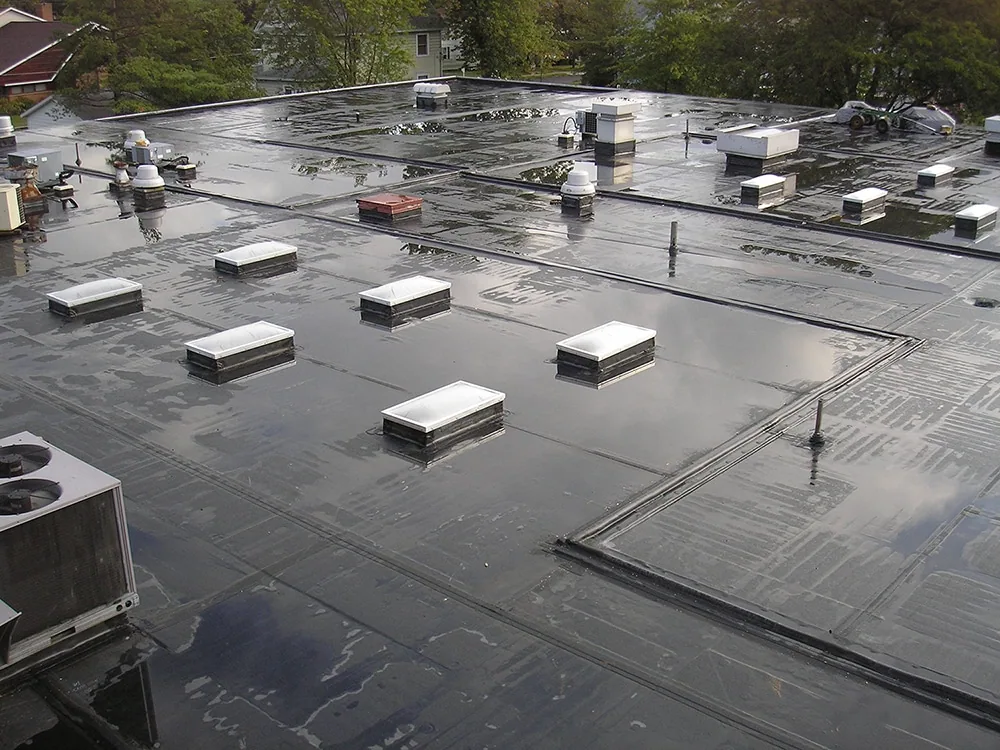
Walking the deck after a rain tells the crew leader more than any drawing. Standing water shows exactly where the roof does not drain, and a flat chalk line around each puddle gives the starting list for the job. Then comes the question of why: a clogged bowl, a drain set too high, a deck that has sagged, or a roof that was never sloped to the outlet.
On low-slope roofs in Federal Way, WA, the drainage system is the part that carries the load of the wet season. Drains, scuppers, gutters, crickets and tapered insulation decide whether rain leaves the roof in an hour or sits on it for days. When one piece fails, the membrane, the seams and the deck all pay for it.
Why does water pond on a commercial roof?
Ponding has four common causes. First, the drain is blocked or partly blocked by debris, so water leaves slower than it arrives. Second, the roof was built too flat, or settled over time, and the low spots sit away from the outlets. Third, the deck or framing has deflected under equipment or snow load, so the surface dips between supports. Fourth, a drain was placed above the low point instead of at it.
The first cause is a maintenance problem and is solved by cleaning. The others are structural or geometric and call for a physical fix. Tacoma sees roughly 155 wet days a year, and Auburn's wettest months are November and December, so a roof that holds water after each storm is under load for a large part of the year. Water that stays on a membrane for long periods speeds up algae growth, seam stress and membrane aging, and it can add significant weight to a deck.
If the problem is chronic, our ponding water roof repair approach starts with elevation readings across the roof, so we fix the right spots.
What do we check on interior drains?
The drain bowl, the clamping ring, the strainer dome and the leader pipe each get a look. We check that the clamping ring is tight and that the membrane is flashed into the bowl with a proper seal, since a leak at a drain often travels down the pipe and shows up far from the roof. We confirm that the strainer is in place, because a missing dome lets debris into the line.
Flow testing comes next. A hose test shows whether the line drains freely or backs up, and a camera pass finds a blockage, a crushed section or a pipe that has separated. Replacing a drain bowl means cutting into the deck and tying the new flashing into the roof, so the replacement is planned with the membrane work around it.
Secondary drains and overflow scuppers also matter. When the primary drain is blocked, the overflow keeps the roof from loading up with water. We check that the overflow sits at the correct height above the primary and that its path is clear.
How do scuppers and gutters get fixed?
Scuppers pass water through the parapet wall, and their flashings take a lot of abuse. The common failures are a split at the corner where the metal liner meets the membrane, a liner too short to project past the wall, and a scupper set so high that water ponds behind it. We replace the liner, rebuild the flashing in the membrane manufacturer's detail and, where needed, lower the opening.
Gutters and downspouts carry the water away from the building. They clog with moss and needles, they pull away from fascia, and their joints open with thermal movement. We clear them, reseal or replace the failed sections and confirm that the downspout outlets discharge away from the foundation or into the storm line. Where the edge metal and gutters are tied together, we repair them as one unit so the gutter does not pull the edge metal loose.
When do crickets and tapered insulation solve it?
A cricket is a small peaked section built behind a curb, a unit or a parapet to push water around an obstruction. Without one, water stalls on the uphill side of a rooftop unit and ponds there. We build crickets from tapered insulation, sized to the curb and set so the slope runs to a drain or scuppers.
For roofs with broader low areas, a tapered insulation system can add slope across large sections. It goes over the existing deck or under a new membrane, and it is planned so the finished heights still clear the flashings, doors and curbs. The taper also adds thermal value, which is worked out together with the insulation and cover board package.
New drains, sumps or relocated outlets are an alternative when the low spot is far from any outlet. The choice comes down to elevations, plumbing access and the interior of the building, so we price both when both are possible.
Which buildings see the most drainage trouble?
Large industrial roofs with long run lengths to the drains, such as the new buildings going up in the Woodbridge industrial park on the former Weyerhaeuser campus, depend on correct slope and sizing from the start. For older roofs, the trouble tends to come from additions: new units, conduit and platforms that interrupt flow. A retail strip, the kind that lines Pacific Highway South, often has many small roof sections, each with its own scupper, and any one of them can clog.
Warehouses in the Kent Valley and Fife often carry rooftop equipment that has been moved or added over time, and each change can create a dam. Kent buildings near trees or loading yards can collect debris faster than most, and they benefit from drain clearing after leaf fall.
Every one of these roofs gets the same first step: a hose test at each outlet and a photo log of where the water goes, so the drainage plan starts from what the roof does and not from what the drawings say.
Commercial Roofing Questions
How much standing water is too much on a commercial roof?
Manufacturers commonly treat water that remains after a couple of dry days as ponding, and some warranties exclude damage from it. The depth and extent matter, since a shallow film on a small area behaves differently from several inches across a bay. We measure the area, mark the depths and tell you whether it needs a physical fix.
Can drains be added to a roof that has none?
Sometimes. Scuppers through the parapet are the simplest addition, as long as the wall allows an opening and the building has a place for water to go. Interior drains require plumbing and a path through the building, which is more involved. We check the structure, the code and the site before suggesting one over the other.
What does overflow protection do for a flat roof?
It limits the depth of water if the main outlets clog, so the load on the deck stays within what the structure can carry. The 2021 International Building Code, as Washington amended it, speaks to secondary drainage on low-slope roofs. We confirm the provision against your roof and the plan reviewer before work begins.
Should I clean the drains myself before the rainy season?
Sweeping debris off the roof is fine if your people have safe access, but the drain line itself, the clamping ring and the flashing need a trained look. We recommend cleaning in September or early October, then again after leaf fall, which fits our preventive maintenance calendar.
Do roof drains need winter protection near the Cascade foothills?
Enumclaw runs about five degrees colder than Seattle and sees several inches of snow a year, so a building there should have its drain bowls, leaders and gutter heat checked before the cold season. Wherever the building sits, we confirm that bowls and leaders are sound, since a cracked pipe fails quietly.
Send the roof plan and a photo of the puddles
Send the roof plan, any drainage drawings and photographs taken after a rain. We will walk the deck with your superintendent, mark the low spots and lay out the drain, scupper and cricket work in order.