Property Types We Roof
Church and House of Worship Roofing in Federal Way, WA
A church job opens at the calendar on the office wall, not at the ladder. The superintendent finds the service times, the weekday programs and the one Saturday each month when the hall is rented out. Only then does he walk the deck and decide what can be open, when, and over which rooms.
A church roof is usually several roofs: a tall sanctuary, a lower fellowship hall, classrooms and an entry canopy, each with its own pitch and age. Federal Way, WA sits between the Kent Valley and Tacoma, and Tacoma logs about 40.8 inches of precipitation on roughly 155 wet days a year. We plan each tear-off section to be sealed before evening and walk the plan with the pastor and the building committee.
What does the first walk of a sanctuary roof include?
We start with the sanctuary because it carries the most consequence. The superintendent walks the ridge, the valleys and every penetration, notes the condition of the flashing at chimneys and bell towers, and photographs the underside of the deck from the attic where access allows.
On any low-slope section, a core shows the layers and the state of the insulation, and a pull test on the fasteners says whether a recover is realistic. The lower roofs over the hall and classrooms get the same walk. The result is a marked-up plan ranking each roof by what sits below it and what a leak would cost the congregation. A church that also runs a food bank, an office or a community hall has public use on weekdays, so we note every space the public uses. Church offices follow the same quiet-hours rule as an office building roof.
How do you set the tear-off limits around services?
Tear-off limits go in paint on the roof before the first panel comes off. For a church, they are drawn around the calendar: the sanctuary roof stays sealed through the weekend, and a section opened on Thursday is dried in before Friday evening.
If an event cannot move, we reschedule the roof section, not the event. Interior protection goes up over the pulpit area, the organ and the fellowship tables before any tear-off above them. If rain is coming, the open edge gets a temporary seal that the crew leader tests by hand, so Sunday morning starts in a dry room. A section that falls behind by Friday gets a phone call to the building contact, and the two decide whether to hold the seal over the weekend or close the area early.
Where do the crane and lay-down yard go on a church lot?
Church lots fill on Sunday and sit empty on Monday. We use that. The crane pick happens on a weekday, with the lay-down yard set at the back of the lot and the parking rows nearest the entrance left open for deliveries and the office.
Fire lanes stay clear, and we mark a walking path to the door for staff and visitors. A church near Federal Way city center may share a lot with a school or a daycare, and the staging plan then adds a fence and a flagger for pickup hours.
What is the order from tear-off to dry-in on a pitched roof?
On a steep roof the order starts with fall protection, then removal of the old material, then inspection of the sheathing. Damaged boards are replaced before underlayment goes down. A temporary cover goes over any section that will not be finished the same day.
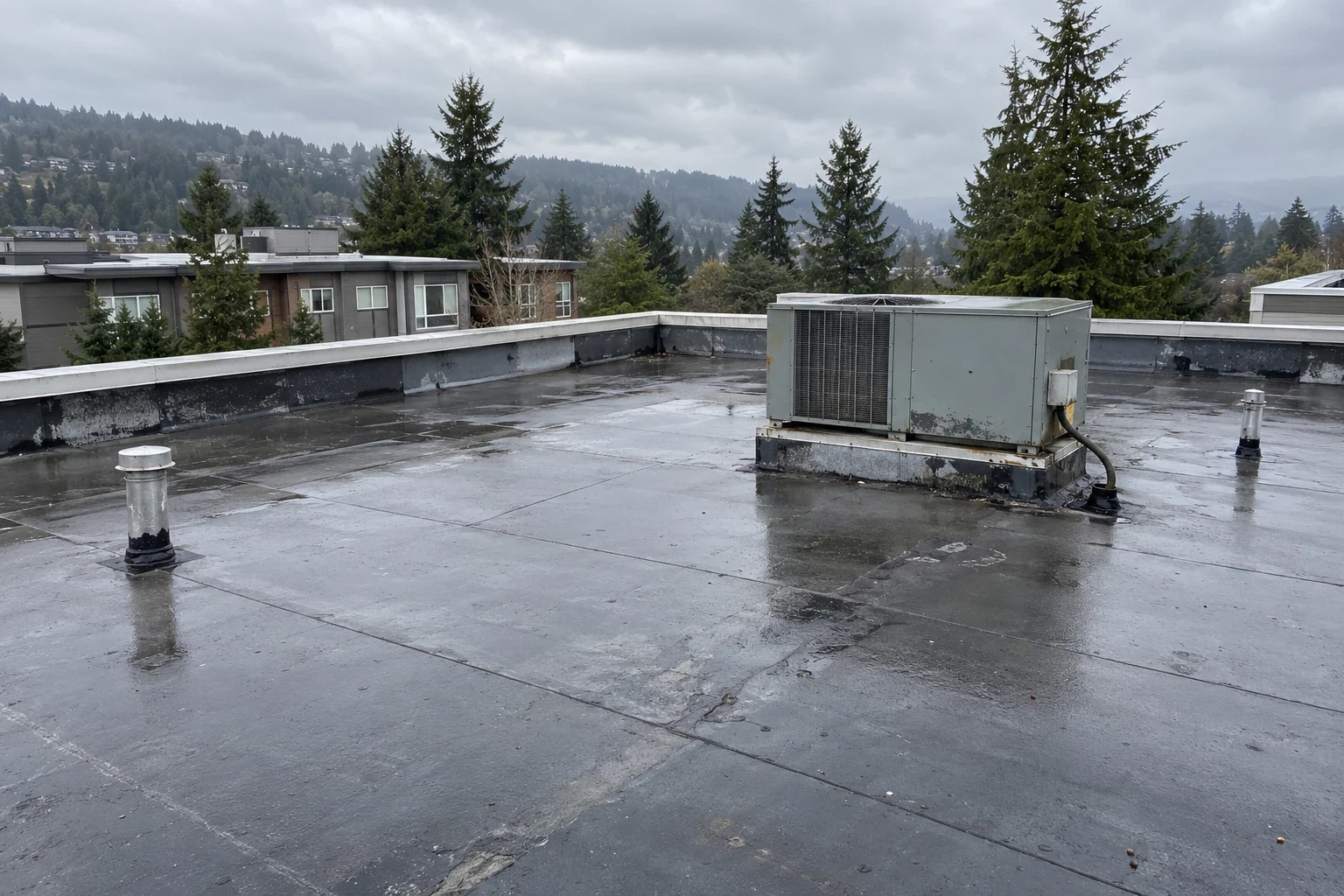
On the low-slope sections, the sequence is the one used for any commercial roof: tear off, replace damaged substrate board, install insulation and set the membrane. A standing seam metal roof is one choice for a steep sanctuary roof, though the sheathing, underlayment and clip layout have to be settled before the panels are ordered. Where the existing low-slope hall roof is dry and sound, a roof recover may keep the cost down and the building in use. Cores tell us which. A recover over wet insulation fails early, and we say so at the walkthrough instead of after the crew has mobilized.
How are steeples, valleys and edges secured?
Steeples, chimneys and bell towers each have a flashing that shapes the repair. We draw every tie-in on the plan, with the counterflashing height and the sealant called out. Valleys get extra attention because they carry the most water.
The eaves and ridge get secured with the November 2024 storm in mind. Enumclaw saw 74 mph in that bomb cyclone, the highest wind of any Washington community. A church roof catches wind at its eaves and ridge, so wind damage repair after any big storm starts with the eaves, the ridge cap and the gutter hangers. We pull on each hanger and test the fasteners at the ridge by hand. Gutters packed with needles and moss hold water against the fascia, so we clear them during the same visit and photograph the downspout outlets.
How do you work with volunteers and a building committee?
Church decisions often run through a committee, and funding may come in phases. We write the scope so it can be split: sanctuary first, hall second, canopy last. Each phase has its own price, schedule and closeout.
Volunteers often want to help. We keep them off the roof and out of the work zone, and we accept help on the ground only with the crew leader's approval. A school roof on the same campus follows the same safety rules, with a fence and a flagger at pickup hours. The building committee gets a one-page summary after each phase listing what was done, what it cost and what the next phase will cover, so a new treasurer can read the history without calling anyone.
What happens at the closeout walk?
The pastor or the facilities lead joins our crew leader for a last walk of the roof, valley by valley. Items that need another visit go on the punch list, marked right where they sit. The folder that follows carries the product data, the warranty forms and photographs taken before each layer was covered.
For a congregation that expects to own the building for decades, that file matters. A roof plan with each repair dated lets the next committee see what was done, and a roof drain and scupper check each fall keeps the lower roofs clear of needles and leaves.
Commercial Roofing Questions
Can we keep holding services during a church reroof?
Yes, in most cases. The sanctuary roof stays sealed through the weekend, work above occupied rooms is protected, and loud steps run on weekdays. We plan the schedule around your service times and any events you cannot move.
Should we replace the sanctuary roof or repair it in sections?
Cores plus a close look at the flashings and valleys decide it. If the sheathing and insulation are sound, section repairs buy years. If wet material covers a large share of the field, replacement is the safer plan. We bring photographs and a marked plan to the walkthrough.
How do you protect the organ and interior furnishings?
Interior protection goes up before any tear-off over the area: plywood, poly and tarps over the organ, pews and altar. We confirm with the facilities lead what must be covered or moved, and the crew leader checks the protection each morning.
Can our congregation phase the work over several years?
Yes. We write the scope so each phase stands alone, with its own tie-ins, price and warranty paperwork. The first phase covers the roof with the most consequence, and later phases follow as funding allows.
What is the best time of year for church roof work?
In Auburn, July is the driest month at 0.9 inches, while November and December run wettest. Big sections go on the summer calendar, and wet-season visits stay limited to repairs the crew can dry in the same day.
Send the roof plan and the calendar
Send the roof plan, the service times and the building committee's schedule. We will walk the sequence, staging and tie-ins with your facilities lead before a number goes on paper.