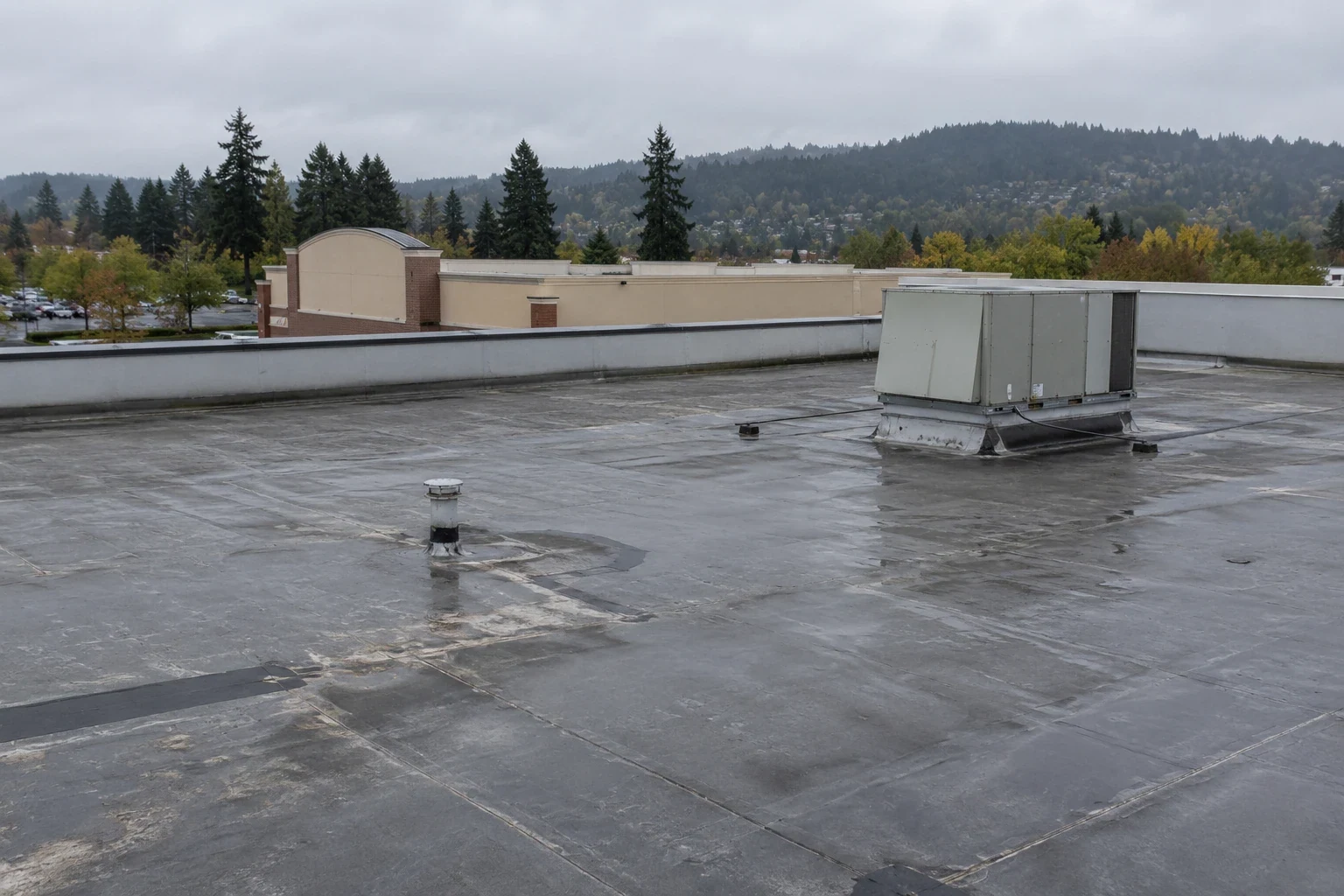
Property Types We Roof
School Roofing in Federal Way, WA
Work on a school roof in Federal Way, WA starts in the winter before the job. The superintendent asks the district for the summer calendar, the list of buildings in the capital plan and the date the first bus rolls in August, then counts backward. Material lead times, permit review and a core-cut visit all have to land before the last day of school.
A school summer has a hard edge on both ends, and the roof sits in the middle of it. We use the spring to cut cores and pull fasteners, order material in time and fix the staging area with the principal. When June arrives, the crew leader already knows where the first tear-off section sits and when the last one gets sealed.
What happens on the deck before summer break?
The first walk happens while students are still in the building, so it stays quiet and quick. We cut cores at each roof area, pull fasteners to test the deck attachment and mark wet insulation in paint. The cores show whether a building can take a recover or needs a full tear-off, and that answer drives the material order.
Schools collect roof types the way campuses collect additions. A main classroom wing, a gym, a cafeteria with kitchen exhaust and a row of portables rarely share a membrane or an age. We list each roof area separately and give the district a ranked scope, with the cores and photographs for each area attached so the board can see why one building comes before another. The roof over a gym with a failing seam and the roof over a storage shed do not compete for the same summer.
How do you set up a work site on a campus with children nearby?
The principal and the district facilities lead walk the site plan with us. Bus lanes, drop-off circles, playground edges and fire lanes come off the table first. The crane pick gets a footprint inside a fenced yard, the lay-down area sits away from entrances and delivery trucks arrive on a route the school approves.
With 2,349 employees, Federal Way Public Schools is one of the city's largest employers, and in Maple Valley the Tahoma School District is the largest public employer. Each campus has its own layout, so every site is walked separately and fenced before the first load arrives. Badge and background-check rules are asked for well ahead of time, and the crew list goes to the district before mobilization. Subcontractors and delivery drivers follow the same rule, so a flatbed never arrives with an unvetted driver at the gate, and the front office has the plates and names on a list.
How does the tear-off run when the building is empty?
An empty building lets the crew work in larger sections than it could during the school year. Even so, the sequence stays the same: strip a section, install insulation and cover board, lay the membrane and seal the edge before the crew leaves. July is the driest month in the region, with Auburn recording 0.9 inches against 6.1 in November, so summer is the natural window for a roof that cannot be trusted through another winter.
The same discipline applies in an early August shower. Nearby Puyallup has recorded a high of 105 F, and Federal Way's monthly averages stay under 71.6 F, so we start early on hot days and finish heat-sensitive seams in the cooler morning hours. If the work is not done by the first week of classes, the remaining sections get a temporary seal, and a smaller crew finishes after school hours.
Which school roof details cause the most trouble?
Kitchen exhaust fans, gym ventilation units, canopy tie-ins and the roof drains that serve long flat spans take most of the leaks. Drains and scuppers are cleaned and checked first, because leaves from nearby trees fill them every fall. Covered walkways are tied to the main building with flashing that moves, and those joints get a drawn detail.
Edges matter on a school because the roof is visible and the wind is real. That is why edge metal gets fastened to a nailer and pull-tested rather than left to hold by hand: the November 2024 bomb cyclone reached 74 mph at Enumclaw, the strongest anywhere in Washington.
What about summer programs and the first week of classes?
Many schools run summer programs, athletics or childcare under the same roof the crew is replacing. We ask the district which wings are in use each week and arrange the zones around them. Noisy work shifts to hours the program chooses, and a barricade separates the crew from the pickup line.
A school reroof is an occupied-building reroofing job whenever anyone is inside, even if only a custodian. Fall protection, debris netting and daily sweeps keep the yard safe, and the edges beside bus lanes and playgrounds are walked for loose material at the end of every shift so nothing blows into a student route. The crew leader signs in with the front office every morning, and the district gets a one-page summary of the day's zone, the open doors and the contact number for questions. For the Des Moines campus that Highline College shares with Central Washington University, the same plan fits a different calendar.
What does the district receive when the job ends?
Before students return, the district's facilities lead and our crew leader walk the roof together. Each tie-in, drain and curb gets looked at, and the punch list for day one goes in paint on the deck. The district keeps layer photographs, core locations, product data sheets and the warranty forms in one folder, and the folder is handed over at the closeout walk.
On a school roof the permit record lists the insulation and fire classification installed, which rest on the 2021 International Building Code as Washington amended it and the commercial energy code, and a district administration building can use the same file format as a government building roof. Districts planning several buildings can send the roof file to the school district capital office as the template for the next summer. A college or university roof follows a similar calendar with different building mixes.
Commercial Roofing Questions
Can a school roof be finished in a single summer?
Often yes, if cores and material orders are done in the spring and the scope fits the break. A large campus is split into buildings and phased over two summers, with the roofs in the worst condition done first. We bring the cores and a schedule to the first planning meeting.
What happens if a leak appears during the school year?
We apply a temporary seal the same day, trace the entry point and record it for the summer scope. A permanent repair during classes happens after hours or on a weekend, and the district chooses the time.
How do you keep children away from the work?
The site is fenced before the first delivery, the crane and lay-down yard sit away from entrances, and the crew follows a route the school approves. Deliveries arrive when students are not in the yard.
Recover or tear-off for a school roof?
Cores decide. A dry roof with a sound deck can take a recover that keeps the building covered throughout. Wet insulation or two existing layers means tear-off, and the district should plan for the extra disposal and time.
What paperwork does the district need from us?
A crew list for background checks, insurance certificates, the product data and the warranty forms. The district's facilities office tells us which forms its procurement rules require.
Send the roof plan and the summer calendar
Send the roof plan, the capital list and the summer break dates. We will walk the sequence, staging and tie-ins with your superintendent before a number goes on paper.