
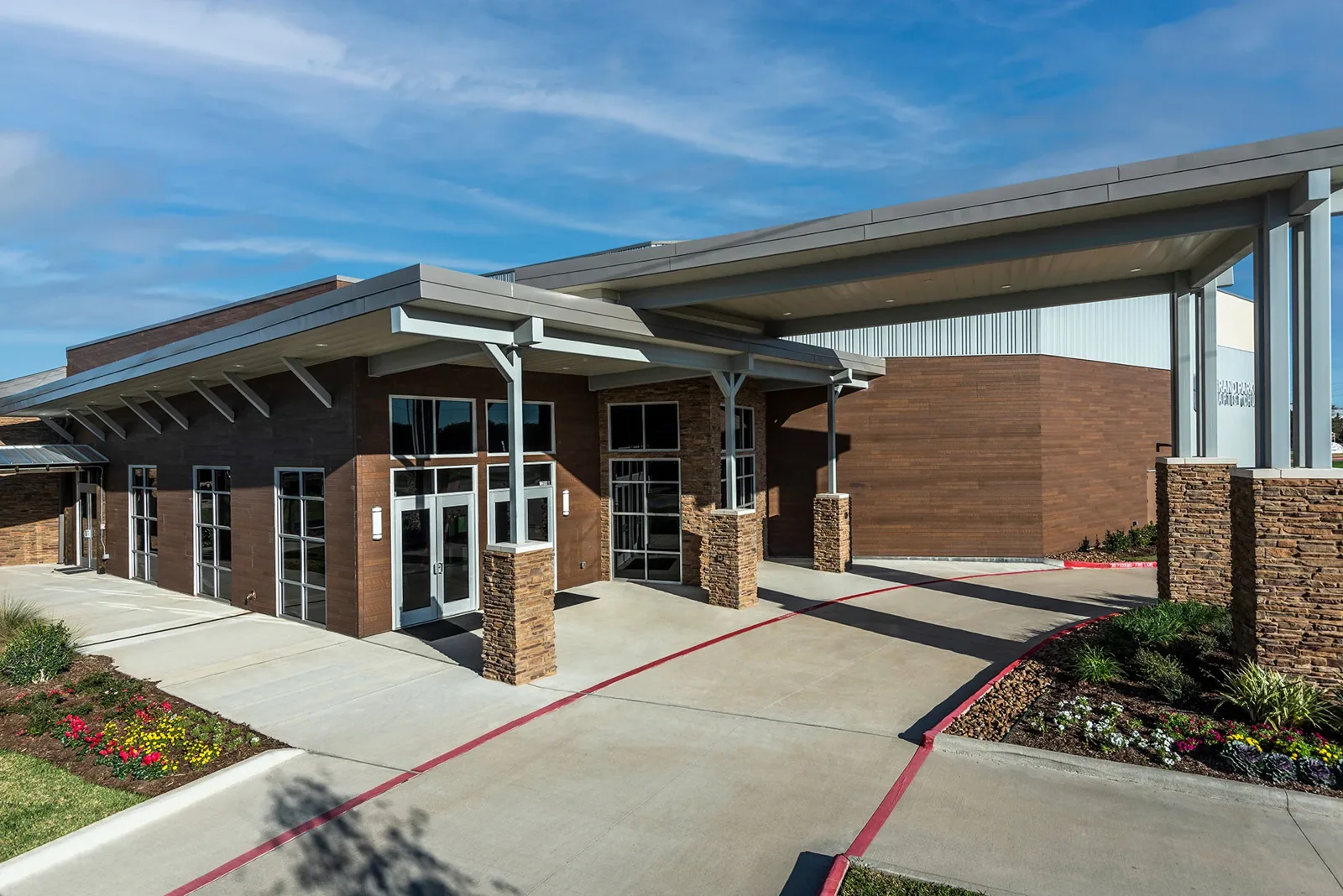
Property Types We Roof
Government and Municipal Building Roofing in Federal Way, WA
A superintendent on a municipal job reads the bid documents before he reads the roof. He checks the submittal list, the substitution rules, the work-hour limits and the closeout requirements, then walks the deck with those pages in hand. The sequence on site follows from what the contract allows, and the submittal list names every product the roof will use before any of it is ordered.
Government roofs in the Federal Way, WA area can range from city offices and libraries to fire stations, a postal facility and the Federal Way Transit Center on 23rd Ave S. Each has a public entrance, a staff entrance and often an emergency function that cannot pause. We plan tear-off limits, staging and dry-in around those constraints, and we walk the plan with the facilities manager before pricing. A city recreation building can share the wide span and humid interior of a fitness center roof, while a library or a city hall has the public counter and records rooms that set its priorities.
What does the first walk of a municipal roof record?
The first walk produces a record a public body can file. Cores are taken at the low corners, the drains and under rooftop units, fasteners are pull-tested and each exposed layer is photographed. The roof plan marks each penetration, each tie-in and each area of ponding.
That record serves the specification writer, the finance office and the next facility manager. A roof condition report ranks each roof across a portfolio by remaining life and consequence of a leak, which supports the capital request. A roof over a dispatch center ranks higher than one over a storage shed.
How are tear-off limits set on a building that stays open?
The limit is drawn on the roof in paint at the start of each day, sized to what the crew can tear off, insulate, install and seal before quitting time. Government buildings often have rooms that cannot be disturbed, such as server rooms, records vaults and evidence storage. Those areas get interior protection first.
A change in the forecast means a temporary seal on the open edge, which the crew leader tests before the crew goes down. Public buildings hold evening meetings and weekend events, so we ask for the calendar and avoid opening the roof above a meeting room the day before one. Records rooms and evidence storage get a moisture check the morning after any rain, and the crew leader reports the readings to the facilities manager. If a reading rises, the work stops until the cause is found and corrected.
Where do the crane, trucks and lay-down yard go on a public site?
Public sites carry foot traffic, parking and bus stops. The lay-down yard goes where it leaves bus stops, fire lanes and accessible routes alone. The crane pick is scheduled for early morning, with flaggers and fencing around the swing radius.
For buildings along Pacific Highway South (SR 99), the main commercial strip, deliveries are timed to avoid peak traffic. Truck routes are planned in advance for any site close to the 348th, 320th or 272nd Street exits off I-5. Access to a secure facility needs badges and escorts, so we submit the crew list early.
What is the dry-in sequence on a government roof?
A section moves through the same steps each time: strip, check the deck, replace soft substrate board, insulate, set the membrane and close the edges. Cover board goes down where foot traffic or rooftop equipment will wear the surface.
Insulation values and attachment follow the 2021 International Building Code, which Washington adopted with state amendments, and the 2021 International Energy Conservation Code, the state's commercial energy code. A TPO roof or a EPDM roof are common on municipal low-slope buildings, though the submittal list decides which products qualify. Fastener patterns follow the manufacturer's data and the wind-uplift requirements in the code, and we run pull tests on the existing deck to confirm that the attachment will hold before a single fastener is ordered.
How do you tie in new work to the existing roof?
Public buildings often have several roof levels from additions over the years. Wings added in different decades rarely share a roof system, which makes the transition the part of the job that controls the warranty. Each transition is shown on the plan with flashing height, termination bar and sealant. At an old addition, a failed flashing often shows up as a stain in the corridor.
Edge securement answers the November 2024 bomb cyclone. The storm drove 74 mph into Enumclaw, the highest reading in Washington. Perimeter metal, its nailer and the wall behind get checked, and pull-test results go in the closeout file. Where a new roof meets an older roof of a different material, we choose a transition detail that both manufacturers accept, draw it on the plan and photograph it before it is covered.
How do you work around staff, the public and emergency functions?
Staff come first, the public second. The crew uses a separate route to the roof, away from the public entrance, and noise is limited during council meetings, court sessions and public hearings. For a fire or police facility, access is planned so the apparatus bay and response routes stay clear at all times.
Federal Way Public Schools, at 2,349 employees, is one of the city's largest employers, and a school roof carries the same summer-window pressure as other public work. The U.S. Postal Service employs 600 in the city. Whatever the owner, we confirm lead times for membrane and insulation when the bid is awarded, so the material is on the lay-down yard before the first tear-off.
What goes in the closeout package for a public owner?
The facilities manager, and the inspector if the contract calls for one, go over the finished roof with our crew leader. Open items go on the punch list, painted at the spot. The turnover set has a marked roof plan, a list of core locations, the fastener patterns, product data and warranty papers.
For a public owner, that file is the record. Checking roof drains and scuppers every fall keeps the building dry between inspections. An office near the city center can share the same format as a library across town.
Commercial Roofing Questions
Can a municipal roof be replaced while the building stays open?
Yes, in most cases. Work proceeds in sections with rooms below protected, and loud steps avoid meetings and public hours. Emergency functions keep their access routes clear throughout, and the facilities manager approves the plan before work starts.
How do you handle the bid documents and submittals?
We review the specification before pricing, flag any product that conflicts with the building code or the roof condition, and submit product data early. Substitutions go through the process the documents require. Lead times for membrane and insulation are confirmed at award.
What does a roof condition report give the finance office?
A ranked list of roofs by remaining life and consequence of a leak, with photographs and cost drivers for repair, recover and replacement. The finance office can spread capital requests over several years, and the report shows why one roof comes before another.
Can you work around security rules at a secure facility?
Yes. We submit the crew list early, follow badge and escort procedures and keep tools and materials inventoried. The superintendent coordinates with the security lead on staging, delivery times and any area where photography is restricted.
Is summer the only good time for a government reroof?
Summer is easiest, because Auburn gets 0.9 inches in July against 6.1 in November. In the wet months a roof that cannot wait is opened in smaller daily areas with each edge temporarily sealed.
Send the roof plan and the project schedule
Send the roof plan, the bid documents and the project schedule. We will walk the sequence, staging and tie-ins with your facilities manager before a number goes on paper.
