Roofing Manufacturers
Holcim Elevate Roofing in Federal Way, WA
Before touching a roof marked with the Holcim Elevate name, the superintendent checks the paper for an older name, because the company was formerly Firestone Building Products and many roofs still carry that label on warranty letters and product tags. The manufacturer makes commercial single-ply roofing, insulation and metal edge products. In Federal Way, WA, a roof from either era is read the same way: seams, edges, flashings and then the field.
These systems are installed, repaired and maintained to the published detail for the sheet on the roof, and a walk with a core cut comes first so the layers get named.
Why do old and new names both show up on the paperwork?
Corporate names change faster than roofs do. A roof installed years ago may have a warranty letter, a product data sheet and a printed sheet edge that all carry the former name, while a new repair kit carries the current one. Both refer to the same family of products, and the repair method follows the sheet, not the label.
We record both names in the file when we see them, along with the date of installation and the installer if known. If a claim ever comes up, a file that shows the old name, the new name and the roof's history spares the owner a week of phone calls. The walk also matches the product on the roof to the right repair materials.
Which single-ply systems are common on commercial roofs?
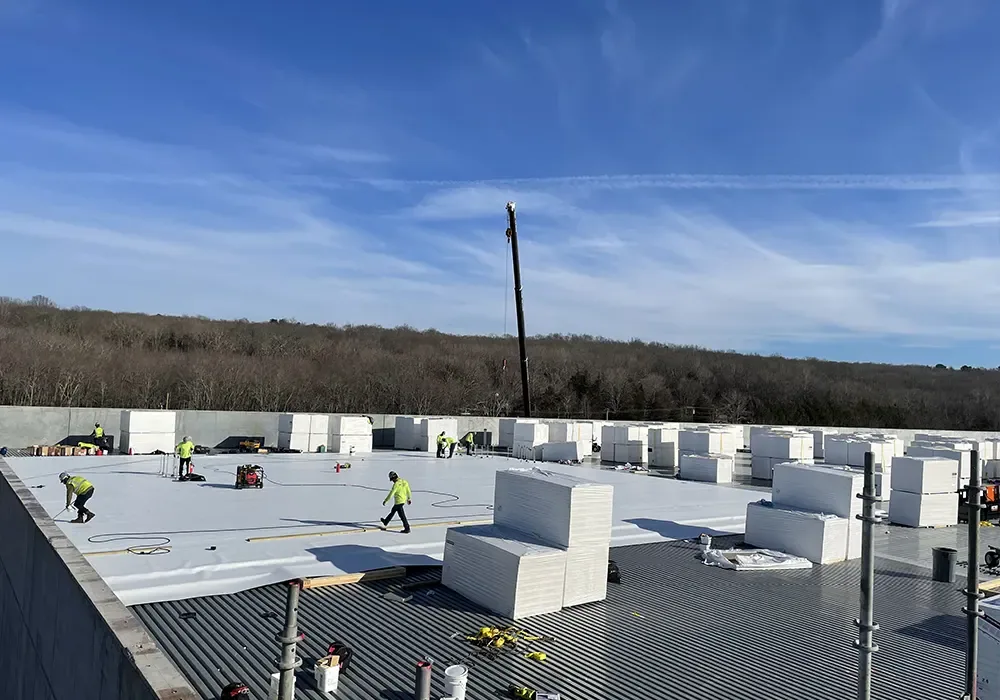
The commercial range centers on single-ply membranes. A rubber sheet like EPDM flexes with the building and is spliced or taped at the seams. A thermoplastic sheet is welded with hot air. Both can be fully adhered, mechanically attached or ballasted over insulation, and the choice depends on the deck, the wind exposure and the structure.
Large roofs with many drains, such as big-box stores, often use a fully adhered rubber sheet because the surface is smooth and the attachment is continuous. A big-box retail roof usually carries a crowd of rooftop units, so the plan includes walk pads on service routes and a flashing count for each curb.
Attachment sets what a wind event can do. A mechanically attached sheet is held by fasteners in rows, and a loose row can flutter. A fully adhered sheet is bonded across its face, and a failed bond shows as a bubble or a soft spot. We probe both on the walk, and a pull test on fasteners tells us whether the deck still holds what the sheet assumes.
How are edges and metal details handled?
Wind starts at the edge. Perimeter metal has to be fastened for the worst day, not the average one, as the windstorm of November 2024 made plain when it reached 74 mph at Enumclaw. We walk every edge, pull-test the fasteners and look for open joints in the coping.
Where metal needs to be replaced, edge metal, coping and gutters are rebuilt as a system: cleats, joints, sealant and the first few feet of membrane that tie into them. A new coping on an old, curled membrane edge does not hold, so the tie-in is part of the scope and the crew leader walks it with the owner at closeout.
Gutters and downspouts are part of the same line. A scupper set too high leaves a pond at the wall, and a cracked downspout joint pours water onto a foundation or a parking lot. We check outlets for size and slope, look for staining below them and note any that need to be reset when the edge metal is replaced.
What does the wet season do to a single-ply install?
Adhesives need dry surfaces and moderate temperatures, and splices need clean laps. Winters here are long and wet, which is hard on exposed splices, and the days when a lap is clean and dry enough to splice or bond can be few between October and spring. Federal Way summers are mild, so cold is rarely the limit. Wet surfaces are.
Each day's opening is held to what the crew can seal by evening. If rain comes early, the day ends with a temporary seal over the open edge, recorded as temporary, and the section is finished on the next dry day. The large tear-offs and recovers sit in the dry months, and the wet months carry repairs, drains and inspections.
Where does this fit in Federal Way?
The Commons at Federal Way, the city's only indoor mall, sits near the main I-5 exit, and Walmart Supercenter, Costco, Fred Meyer and The Home Depot are among the larger retail and service employers. Around the city center, a large retail roof with rooftop equipment is the kind of job where a fully adhered sheet and a strict flashing schedule get compared against the alternatives.
A big retail building can carry any membrane, so the walk and the core cut decide. The same approach applies to the Woodbridge buildings on the former Weyerhaeuser campus, where the first walk records what was installed and starts the file.
Auburn, Kent and Fife add another set of settings, since their warehouse and manufacturing buildings are a different scale of job. For those roofs, the walk turns to seam probing, drains and edge attachment, and the file marks which sections share the same sheet so a repair on one applies to the others.
What does the owner receive at closeout?
The owner receives the photo set, the layer log and the repair record, with section numbers tied to the plan. If the roof carries a warranty, the condition report sits beside its terms so a claim begins with a clear picture. We read warranty terms before every repair and follow the published method.
Owners comparing alternatives can look at Versico or Sika Sarnafil, both of which supply single-ply systems, and the walk will show which assembly suits the deck and the drains.
Commercial Roofing Questions
Does the old Firestone name on my warranty still count?
Read the letter and, if needed, ask the manufacturer to confirm. A name change does not usually end a warranty, but the paperwork should show who stands behind the roof today. We note both names in the file so the answer is on hand if a claim comes up.
Should a leaking EPDM seam be patched or re-spliced?
Re-splice if the lap is wide enough and the sheet is clean. Patch with a cover strip if the lap is short or the rubber is chalked. Either way, the area gets cleaned and primed first, because a repair on dirt fails in a season.
How often should edge metal be checked?
Walk the perimeter after every major windstorm and at least once before the wet season. Look for loose joints, lifted cleats and gaps at corners. A small lift caught in October is an afternoon's work, and the same lift in a windstorm can peel a large section.
Can walk pads be added to an existing roof?
Yes. They are bonded or welded to a clean sheet along service routes, and they spread foot load and protect the membrane. We place them from the hatch to each unit and note them on the plan so maintenance crews know the route.
What if parts of the roof have different membranes?
Mixed roofs are common after additions. Each area gets its own repair method, and the tie-in between them gets extra attention because incompatible materials do not bond. The file maps the areas so a future crew sees where one system ends and the next begins.
Send the paperwork and the roof plan
Send the GC's roof plan, any warranty letter and the age of the sheet. We will walk the seams, edges and tie-ins with your superintendent and name the layers before a price goes on paper.