
Roofing Manufacturers
Johns Manville Roofing in Federal Way, WA
On a roof with a Johns Manville system, the superintendent starts at the insulation, because insulation is a large part of the manufacturer's commercial line. Johns Manville makes roofing membranes, built-up and single-ply systems and the insulation boards that sit under them. A warehouse in Federal Way, WA that carries one of those assemblies is read from the bottom up: the deck, the insulation, the cover board and then the membrane.
We install, repair and maintain these assemblies by the published detail for the system found on the roof. The core cut tells us what that system is.
What is in a Johns Manville roof stack?
A typical low-slope stack has a deck, a vapor control layer where needed, one or more layers of rigid insulation, a cover board and a membrane. The insulation does the thermal work. The cover board protects it from foot traffic and hail and gives the membrane a uniform surface. The membrane sheds water.
When a roof leaks, the question is which layer failed. A split seam in the membrane can wet the insulation, but a crushed cover board or a wet insulation seam can also push moisture upward. We log each layer thickness from the core cut and read the moisture meter on each, so the repair addresses the layer that failed, not just the stain.
Fasteners and adhesives belong in that log too. A board held down with plates and screws shows a pattern on the deck, while a board set in adhesive shows ribbons. We pull a few fasteners to see whether the deck still grips them, because corroded screws or a soft deck change how the whole stack should be attached.
How does insulation get repaired or replaced?
Wet insulation is cut out in squares, the surrounding area is checked with a meter, and new boards are installed with staggered joints and the same fastening pattern as the surrounding roof. A cover board and insulation repair is only as good as its tie-in to the membrane, so the new patch is lapped and sealed in the manufacturer's method.
Tapered insulation solves drainage problems that a patch cannot. If a roof ponds after every storm, the answer is to shape the surface so water reaches a drain, and tapered boards do that. On a recover, the new insulation goes over the old only where the old tests dry, and the plan checks wall heights and drain levels first.
Seams between boards are a quiet source of trouble. A gap wider than a finger lets the membrane sag into it and crack, so we fill or re-lay joints before the membrane goes back down. Layer one and layer two are staggered so no joint lines up with the one below, which keeps heat and water from finding a straight path through.
What do energy rules add to a replacement?
Washington applies the 2021 International Building Code with its own amendments, the most recent effective March 15, 2024. Under Chapter 51-11C WAC the commercial energy code is the 2021 IECC. A full replacement can trigger insulation requirements that a patch does not.
That is why the walk records the existing insulation thickness and type before pricing. If the roof is heading toward replacement, the energy requirement shapes the insulation line, and the plan shows the owner both a repair path and a replacement path. The permit conversation then starts with real numbers from the cores.
How does wet weather change insulation work?
Insulation is the layer a wet season hurts most. Federal Way's long wet winters give it plenty of chances, and a roof that stays damp between storms never gets the chance to dry out. A board left uncovered during a rain absorbs water, and a roof sealed over wet board holds the problem for years.
So the crew stores insulation off the roof and under cover, opens only the area it can close by evening and installs the membrane or a temporary seal over every board laid that day. The dry months carry the large replacements, and the wet months carry repairs and small sections, with moisture readings taken before every cover-up.
Where does this show up in the Kent Valley and the Tideflats?
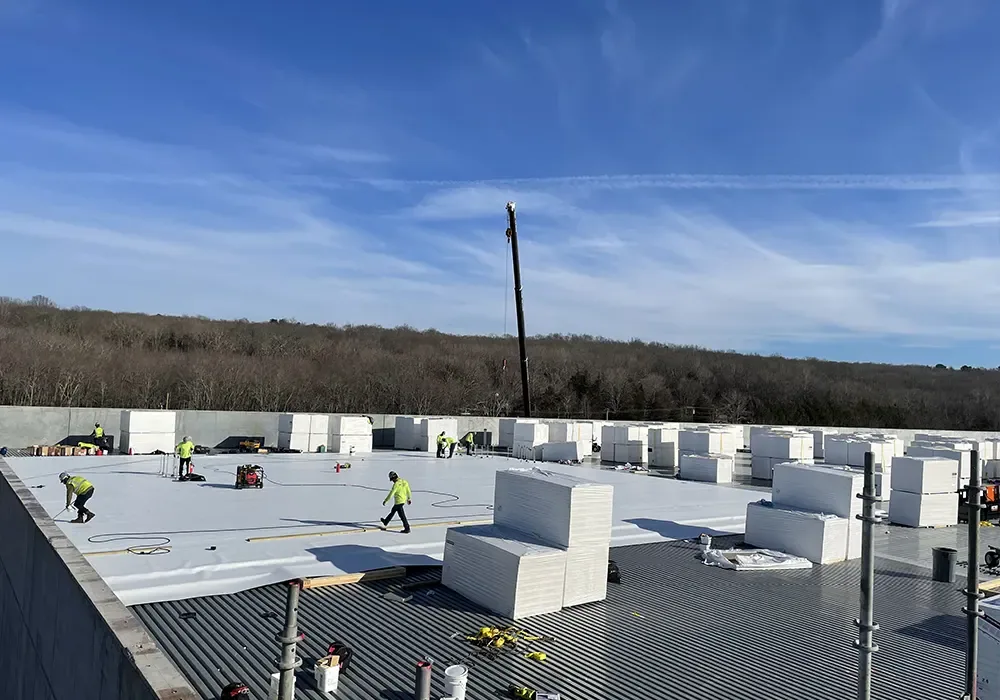
The Kent Valley, Auburn and Fife hold warehouse, distribution and aerospace manufacturing buildings, and the Port of Tacoma adds terminals, warehousing, distribution and manufacturing on more than 2,400 acres. On a warehouse roof, a big field of insulation sits under the membrane, so wet board and ponding are the main questions.
Walks on those roofs track thickness, cover board condition and drain slope. A Port of Tacoma Tideflats roof needs a staging plan that respects truck traffic, and the lay-down yard is chosen with the facility manager before the crane arrives.
Where a manufacturing building carries roof-mounted process equipment, each unit sits on a curb that needs its own flashing check. Insulation near those curbs gets extra readings, since a small leak at a curb can wet a wide area of board without any visible stain.
What does the owner receive at closeout?
The owner receives the layer log, the moisture map, the photos and the repair record. If the roof carries a manufacturer warranty, the file records its notice and repair rules. When the roof nears the end of its term, the plan offers a replacement scope and a recover option side by side.
For owners comparing assemblies, GAF and Holcim Elevate also sell commercial systems with insulation and membranes, and the walk shows which fits the deck and the drainage best.
The closeout walk reviews the layer log against what was installed, and the superintendent signs the punch list with the owner. Any insulation that was replaced is recorded by area and thickness, so the next owner can read the roof like a drawing instead of guessing. The layer log also names the fastener type and spacing found at the core cuts, which saves a later crew from guessing when a repair meets the same board.
Commercial Roofing Questions
Why does wet insulation matter if the membrane looks fine?
Wet insulation loses much of its thermal value and can hold water against the deck, which rusts fasteners and corrodes steel. A sound membrane can sit on a wet roof for years. Cores and an infrared scan find it before the deck is damaged.
How thick should replacement insulation be?
The energy code sets the minimum for a replacement, and the existing thickness sets the starting point. Wall heights, door thresholds and drain levels limit how much can be added. We measure those on the walk and give the owner a thickness that meets the code and fits the building.
Can only the wet section of insulation be replaced?
Yes, when the wet area is small and the rest tests dry. The scan sets the boundary, and we cut a little beyond it. A large wet area usually moves the roof toward replacement, because patching around it leaves seams that leak.
What is a cover board and do I need one?
A cover board is a rigid sheet between the insulation and the membrane. It protects the insulation from foot traffic and hail and gives the membrane a flat base. Most owners want one on busy roofs, and we recommend it wherever rooftop units need regular service.
How do I keep insulation dry during a replacement?
Store it off the deck, under cover, and install only what can be covered the same day. We take moisture readings at the start of the day and again before closing each section, and any board that gets wet comes out before the membrane goes on.
Send the roof plan and the core results
Send the roof plan, any earlier core cuts and the warranty letter. We will go over the stack and the drainage with your superintendent before we put a price on paper.