
Service Areas
Commercial Roofing in Edgewood, WA
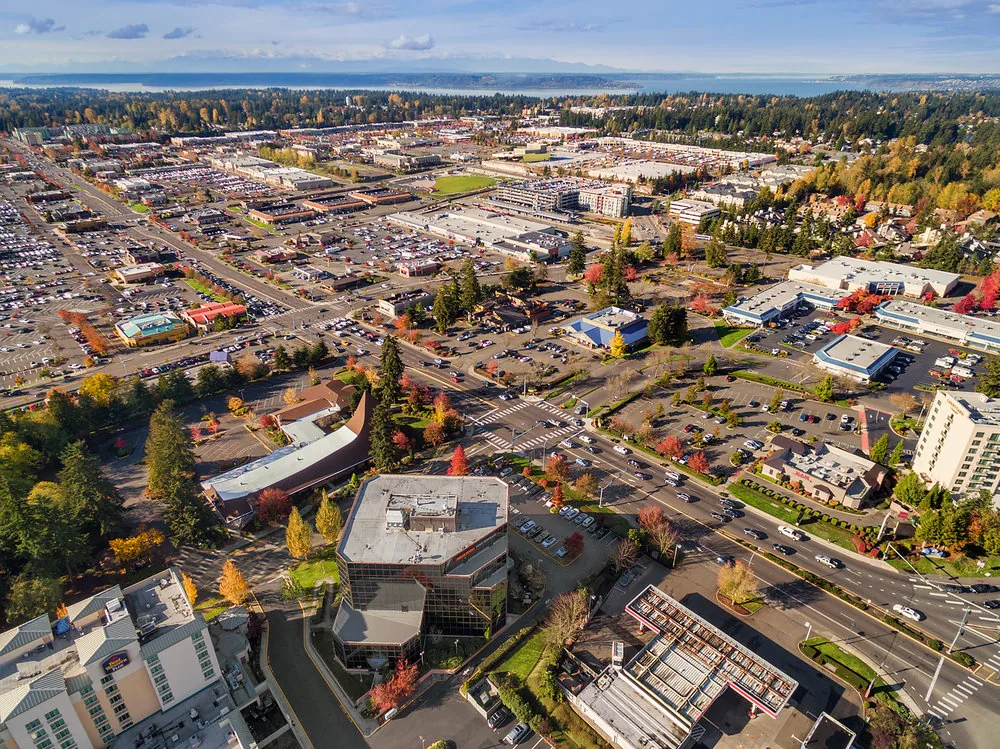
Walking the deck on an Edgewood roof starts with locating the drains, because on a flat roof everything else follows from where the water is supposed to go. Edgewood had 12,327 residents in 2020 and lies near Fife, Milton, Federal Way, Sumner and Puyallup. SR 161, also called Meridian Avenue East, runs through the city, and the Nyholm Windmill is its symbol. Edgewood and Milton together are informally called North Hill.
We reach Edgewood from Federal Way, WA, and the commercial roofs here get the same treatment we give any low-slope or metal roof: a mapped inspection, core cuts where the field looks suspect, a written repair list and a sequence that moves from tear-off to dry-in to closeout in an order the owner can follow.
Where does the water go when the drains fail?
On a low-slope roof, drains, scuppers and gutters carry the load, and a clogged one turns a roof into a shallow pond. Standing water adds weight, stresses seams and speeds the wear of the membrane. During the first walk we clear every drain, run water to test the flow and note any area that holds water more than a day after rain. Those low spots show on the roof plan with their depth, and the plan marks whether tapered insulation, a new drain or a different outlet will fix them.
If ponding has been there for years, the membrane underneath is often the first thing to give out. A ponding water repair that raises the low spot with tapered board usually costs less than replacing a membrane that has soaked for years, and it should happen at the same time as any membrane work so the slope and the sheet are done together.
Gutters and downspouts on a low-slope building get the same attention. We check that outlets are not crushed, that joints are sealed and that the discharge reaches a place where water can leave the site without running across the lot. A drain that is clear on the roof but blocked at the bottom still backs up, so the check runs from the strainer down to the pipe's outlet, and we write down whatever the plumbing contractor has to fix.
What do roofs along SR 161 need from the first walk?
A state route like SR 161 typically brings customers, deliveries and truck traffic past the front of a building, and that changes how a roof job is staged. Parking and the front door stay open, the lay-down yard goes where it does not block deliveries, and the crane pick is scheduled for hours when the street is quieter. We confirm these points with the property manager before mobilizing and write them on the plan, along with the hours the street is quietest and the route a truck takes to reach the lay-down yard without crossing the customer entrance.
The roof itself is judged on its own condition. Neighboring buildings can share a street and still need different work: one needs new flashing at the parapet, another needs a drain relocated, a third needs a full recover. We do not assume the answer from the address. We take the cores, press the seams and let the roof tell us what it needs.
How does the weather change the schedule?
Weather records come from neighboring cities. Auburn's wet season peaks in November and December, Tacoma has roughly 155 wet days a year, and the November 2024 bomb cyclone drove Enumclaw to 74 mph.
Both numbers go into the plan. The rain sets how much roof can be open on a given day, and the crew leader confirms the forecast with the property manager the afternoon before any open day. The wind sets how the perimeter is fastened, since edges and corners take the first uplift. On every job we seal the open area by evening and stage a temporary seal in case a front moves in overnight. Edge metal is fastened to the wall and the nailer, and the new membrane is tied in with the existing roof only after the old edge has been checked, with the perimeter photographed before the new sheet covers it.
Should the owner repair, coat or replace?
The answer is in the cores. A roof with dry insulation and a membrane that still welds or bonds can take targeted repairs, and a preventive maintenance visit twice a year catches the next small failure. A roof with sound insulation but a worn surface can take a silicone coating over cleaned and repaired seams. When wet insulation runs across much of the field, replacement is the sound choice.
Three things drive cost: the share of the roof that is wet, how difficult the roof is to reach, and the number of penetrations the membrane must be sealed around. A roof with many curbs, vents and conduit supports takes more labor per area than an open field. We price each section separately so the owner can see which part of the job is driving the total.
Can one plan cover buildings across North Hill?
Yes. An owner with property in Edgewood and Milton can run one inspection format across all of it, and the crew can group the work by condition and by season. The same applies to an owner whose other buildings sit in Fife or Puyallup, both of which lie near Edgewood.
A shared file helps with budgeting. The worst roofs go first, the middle group goes into the following year, and the healthy ones stay on a maintenance schedule. The owner sees the whole portfolio on one page, which makes a roof capital plan easier to defend with a lender or a board.
Commercial Roofing Questions
What happens to a roof if the ponding is ignored for another winter?
The water keeps adding weight and keeps working at the seams, so the repair area grows. Insulation under a ponded spot absorbs moisture and loses its value, and by spring the patch you could have made in the fall becomes a section replacement. We mark the depth and location of each pond so the owner can see how it changes.
Can you keep a storefront open during a reroof?
In most cases the doors stay open. We set a lay-down yard and crane position that leave the entrance and customer parking clear, schedule noisy steps for the hours the manager picks, and fence off the ground under the work. Each tenant is told in advance what part of the roof will be open that day.
How much notice do you need to start a job?
Notice depends on the permit, the material lead time and the weather window. We confirm each of those during the first walk and give a start date with the steps leading up to it. If a roof is leaking now, we dry it in first with a temporary repair and then plan the permanent work.
What does a repair list from you look like?
It is a marked roof plan with each item numbered, photographed and priced, and each one marked as patch, fix or replace. The owner can approve the whole list or pick items, and we say which ones protect the interior first. Each item carries the photograph that explains it.
Do you handle insurance paperwork after a storm?
We document the damage with dated photographs, moisture findings and a written scope, and we provide those to the owner and the insurer. Dry-in comes first, so that the claim review does not run while more water gets in.
Send the roof plan and the delivery schedule
Send the roof plan, the hours when deliveries and customers arrive, and the places you have seen water. We will walk the sequence, staging and tie-ins with your superintendent before a number goes on paper.