
Commercial Roofing Services
Preventive Roof Maintenance in Federal Way, WA
A maintenance visit starts the way a tear-off does: the crew leader walks the deck with the last report in hand and a marker in the other. Every drain, curb, seam and termination from the previous visit gets checked against what was written down, so nothing is judged from memory. For a Federal Way, WA building, that walk is the difference between a small repair in September and a wet ceiling tile in December.
Preventive maintenance is a program, not a single call. We set the visits on a calendar that fits the building, clear what the roof sheds, repair what has started to open, and leave the owner a day-one punch list of what remains. The goal is simple: find the failing detail while it is still a patch, and keep the manufacturer paperwork in order while we do it.
When in the year should the visits happen?
In the Green River corridor, Auburn picks up roughly 37 inches of precipitation a year, and its wettest months are November and December. Tacoma runs closer to 41 inches over roughly 155 wet days. Those numbers set the calendar. A fall visit belongs in September or early October, before the gutters and scuppers fill with needles and leaf litter and before the first long soaking rain.
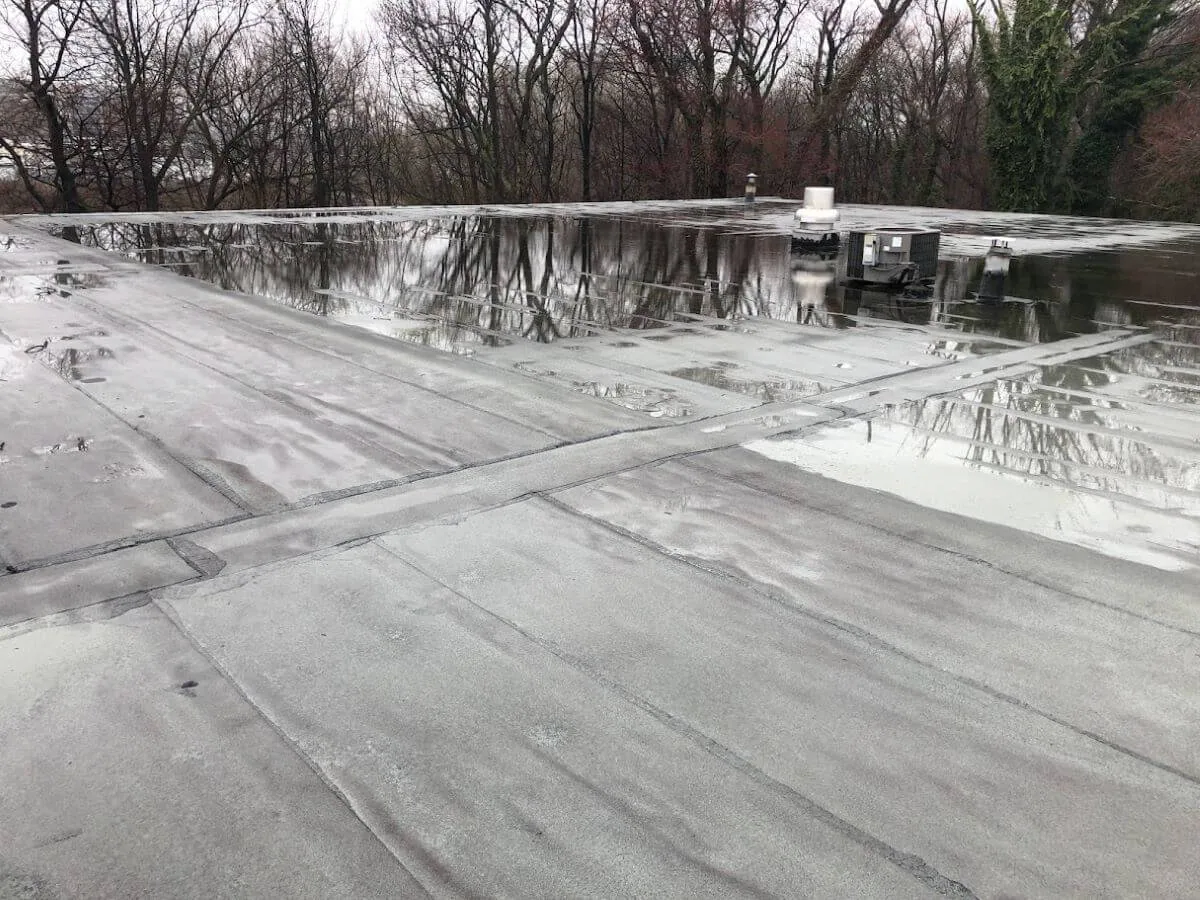
The second visit comes after the wet season has finished testing the roof, usually in April or May. That is when we find the seams that opened under winter ponding, the sealant that shrank in the cold, and the fasteners that backed out of a metal panel. July is the driest month, so it is also the month when heavier repairs, such as a re-flashed curb or a new section of membrane, can be done without a rain delay.
What does a visit cover on the roof?
The first pass is clearing. Drains, scuppers, gutters and downspouts are cleaned by hand, and we confirm that water leaves the roof at each outlet instead of backing up behind it. Debris around curbs and under equipment stands comes off too, since a pile of wet litter holds water against flashing for weeks.
The second pass is inspection with the hands, not just the eyes. We probe membrane seams, press on flashing terminations, check pitch pans and sealant joints, and look for blisters, splits, punctures and loose edge metal. On a mechanically attached system we check for fasteners that have lifted and for billowing that suggests an attachment problem. On a coated roof we look for thin spots, peeling and ponding stains that show where the coating is wearing first.
The third pass is the small repair work that is cheaper to do on the spot than to schedule later: resealing a lifted termination, patching a puncture left by a service technician, replacing a cracked boot on a pipe, and tightening edge metal. Each item is photographed and logged, and anything bigger goes on the list.
How does the program change by building type?
A Woodbridge industrial building on the former Weyerhaeuser campus east of I-5 has a very different roof from a strip center on Pacific Highway South. The industrial building may have a large single-ply field with few penetrations and long drainage runs, so the visit leans on seams, drains and perimeter details. The retail strip has a patchwork of tenant equipment, kitchen exhausts and repeated service traffic, so the visit leans on penetrations, walk paths and grease control.
Warehouses in the Kent Valley and Fife can carry dock canopies, skylights and a steady stream of rooftop equipment installed over the years by different trades. Each of those is a place where a previous technician may have left a puncture or a loose cap. We walk those areas first and photograph them.
Medical and school buildings add access rules. A clinic roof near air intakes needs work scheduled around ventilation, and a school roof needs the crew gone before students arrive.
What goes in the written record?
Every visit ends with a closeout walk and a written report. The report lists what we cleared, what we repaired, what we found and what we recommend, with a photograph for each item. We keep a running log so the owner or the property manager can see the roof's condition across visits, not just the latest one.
That log is also the paperwork a roof warranty reviewer asks for. Most membrane manufacturers expect an owner to keep the roof maintained, and a dated record of inspections and repairs shows that the work was done. A buyer's roof survey also goes faster when the maintenance history is on hand. For owners with several buildings, the same format across multi-site roof programs makes comparing roofs easier.
The report also supports roof capital planning. When the log shows the same seam failing in the same spot, or ponding that returns after every rain, it is time to plan a coating or replacement, and the owner has the evidence to budget it.
What drives the cost of a maintenance program?
Four things move the price: the roof's size and access, the number of penetrations, the age and type of the membrane, and the visit count. A roof reached through a tenant suite or a staged lift takes longer than one with a fixed ladder.
Roof age matters because older membranes need more repairs per visit. A single-ply roof near the end of its service life may need patching on every visit, and at some point the repair spend is better directed toward a coating restoration or a new system. We say so when the log points that way.
Repairs found during a visit are priced apart from the visit, and nothing beyond routine clearing and minor sealing proceeds without approval.
What if a leak starts between visits?
Between visits, a leak call is answered at any hour and on holidays, and the crew that responds already has the roof's log. A temporary seal goes on first to stop the entry, then the cause is traced and a permanent repair is scheduled. For owners who need an after-hours response on a larger leak, our emergency roof repair crew works from the same records.
Commercial Roofing Questions
How many visits a year does a Federal Way warehouse roof need?
Most low-slope warehouse roofs do well with two visits, one in September or early October and one in April or May. Roofs under trees, near freeway dust, or carrying many rooftop units often add a light third visit after leaf fall. We set the count after the first walk, based on how fast the drains foul and how many penetrations the roof carries, and we write the recommendation into the first report so the schedule is not a guess.
Will maintenance keep my roof warranty in force?
A maintenance record does not change what a warranty covers, but it does show that the owner kept the roof in the condition the manufacturer expects. Many warranty terms require periodic inspection and prompt repair of damage. Our reports date every visit, list every repair and carry photographs, so that if a claim is ever filed the history is already assembled. Check the terms of your own warranty for the specific wording.
Can maintenance be done while tenants are working below?
Yes, and most of it is. Clearing drains, sealing a termination and patching a puncture happen on the roof and rarely disturb the floor below. When a visit needs access through a tenant suite or near fresh-air intakes, we give the property manager the day, the route and the contact name ahead of time. Noisy work such as fastener replacement can be scheduled for early morning or a quiet weekend.
What does a maintenance visit find that an annual inspection misses?
Short intervals catch change. A seam that was tight in spring and open by fall, or a drain that fouled twice, shows up in the log as a trend. A single yearly look gives a snapshot, while two or three visits show how the roof behaves through the wet months, and that trend is what lets us call a repair early and recommend replacement only when the record supports it.
Send the roof plan and the visit schedule
Send us the roof plan, any past reports and the dates your tenants need protected. We will walk the sequence with your superintendent or property manager, set the visit calendar and agree on the records before the first visit is priced.