
Commercial Roofing Services
Storm Damage Roof Repair in Federal Way, WA
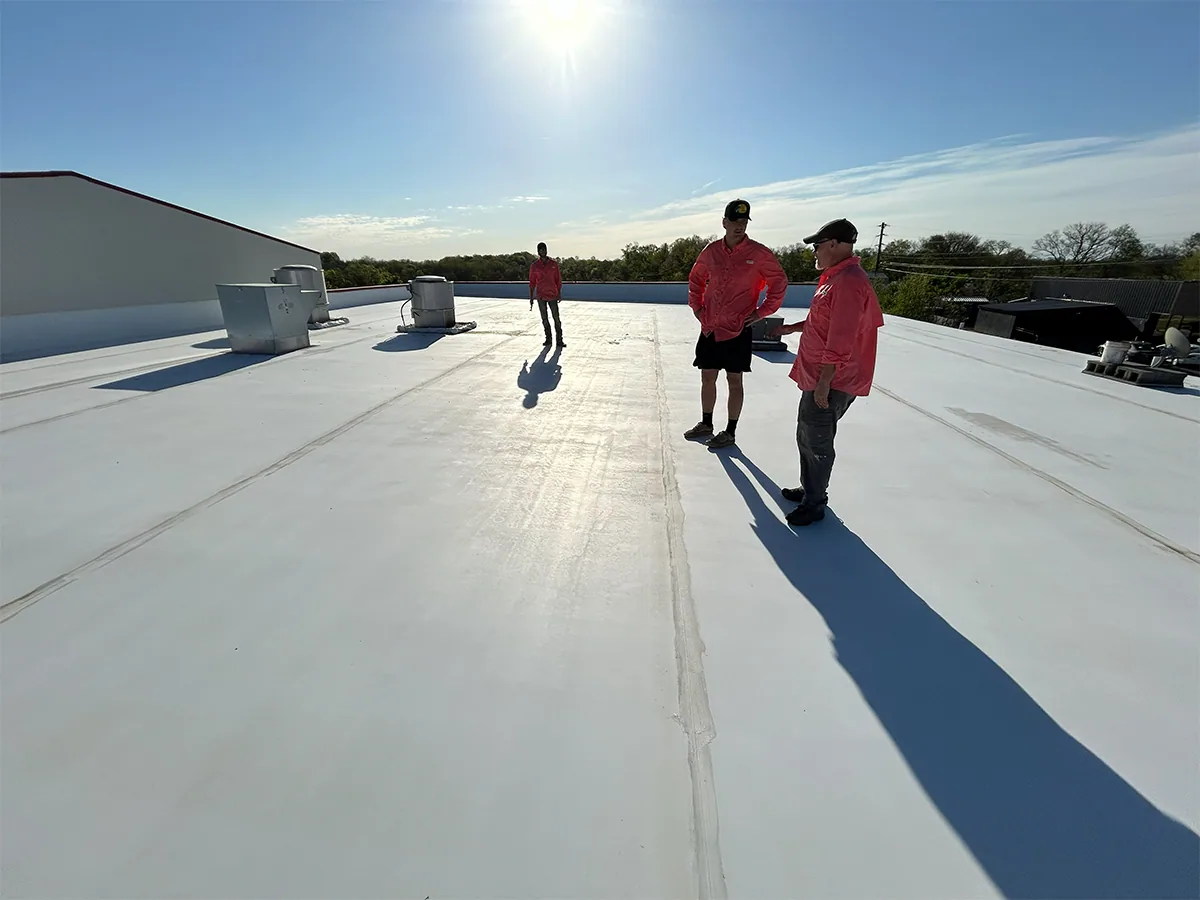
After a storm, the first job is to get up on the roof and mark what the wind and debris did. The crew leader walks the perimeter before anything else, because edges and corners are where a Puget Sound windstorm does its work. Lifted metal, curled membrane, and tree limbs on the deck all get chalked and photographed before a single tool comes out.
In Federal Way, WA, storm damage on commercial roofs comes mostly from wind and the debris it carries, followed by heavy rain that finds any opening the wind has made. The work runs in a set order: stop the water with a temporary seal, assess and document the damage, then make the permanent repair. Each step is recorded so the owner has a clean file for the insurer.
What happens in the first hours after the storm?
Water entry comes first. If a membrane has peeled back at a corner or a limb has punctured the deck surface, the crew installs a temporary seal using sheet membrane, tarp, or sealant patches, depending on the substrate. The goal is to dry-in the opening, not to repair it, so the building stays protected until materials and dry weather line up.
Interior damage is checked next. We look at ceiling tiles, insulation, stored goods and electrical equipment below the opening and advise the property manager on what to protect or move. Where wet insulation sits under the membrane, we mark it so it can be removed, since wet insulation left in place keeps feeding moisture back into the building.
The response runs around the clock and on holidays. A call to our emergency roof repair line brings a crew leader to the site with the materials for a temporary seal, and the damage assessment follows in daylight.
Which parts of the roof does a windstorm hit first?
Wind lifts the roof from the edges. A bomb cyclone in November 2024 sent 74 mph gusts across Enumclaw, the strongest of any Washington community, and it shows why an edge detail has to be designed and installed for real load. Perimeter and corner zones see the highest uplift, which is why coping, edge metal and the first rows of fasteners are the first things we check.
On a mechanically attached single-ply roof, wind can pull fasteners through the membrane or let the sheet flutter and wear at the plates. On an adhered system, a lifted edge can strip the bond across a wide strip. On a standing seam metal roof, we look for loose clips, bent panels and displaced trim, and for any fastener that has backed out.
Rooftop equipment gets checked as well. Unit covers, curb flashings, exhaust caps and conduit supports are all places where a gust finds a loose item and turns it into a projectile or a leak. Lifted edges and displaced coping are repaired as wind damage, with the fastener pattern corrected, not just resealed.
What do fallen limbs and flying debris do?
A windstorm brings down branches. When a limb lands on the membrane, the damage can range from a surface scuff to a full puncture through the insulation. A heavy branch can also crush a drain bowl or crack a scupper, and a crushed outlet turns a rainstorm into a ponding problem.
We cut and remove debris first, then inspect the area under it, since a clean surface often hides a split. Puncture repair follows the membrane type: heat-welded patches on TPO and PVC, cured patches on EPDM, and torch or cold-applied patches on modified bitumen. If the insulation below has been crushed or wetted, it is cut out and replaced so the patch has a sound base. Small tears and holes are handled as membrane puncture repair.
How is the damage documented for the insurer?
Every storm repair file begins with date-stamped photographs of the roof before cleanup, taken from several angles. We add measured sketches of the damaged areas, a written description of the cause where the evidence supports one, and the temporary measures taken. Receipts for emergency work are kept with the file.
That package gives the owner and the adjuster a shared record to work from. The roof's age and prior condition matter to a claim, so we separate storm-caused damage from wear that was already there, and we write each in plain terms. The owner decides what to submit, and we supply an accurate record through roof insurance claim assistance.
How is the permanent repair scheduled?
Permanent repair depends on materials, deck condition and weather. The Federal Way area sees most of its rain from October through March, so a repair done in the wet months may need a staged plan: patch and seal for the winter, then complete the repair in the dry stretch. Auburn's roughly 37 inches of yearly precipitation peak in November and December, which is why we ask whether a repair can safely wait for July before accepting a delay.
Where a roof has taken heavy damage across a large area, a repair patchwork can cost more than a new section. We lay out both choices, with the labor, material and downtime for each, and the owner chooses. Large industrial buildings in the Kent Valley and Fife, and big-box retail along Pacific Highway South, can have the roof area to justify replacing a damaged zone rather than patching it in pieces.
Commercial Roofing Questions
Should we call the insurer first or the roofer first?
Call us first for the temporary seal, since stopping water entry is usually expected of the owner and reduces the final loss. Take photographs of the damage before and after the seal goes on, keep every receipt, and notify the insurer the same day. We provide the documentation that goes with the claim, and the adjuster inspects on their own schedule.
How fast can a crew reach a damaged warehouse in the Kent Valley?
We answer calls at any hour, including holidays, and the arrival time depends on the number of calls after a storm and the distance to the site. When a regional windstorm sends many calls at once, the crew leader triages by water entry first, then by occupancy and by stored goods. Send the address and a photograph of the damage so the first crew arrives with the right materials.
Can a damaged roof be repaired in the rain?
A temporary seal can go on in light rain on a surface that can be dried and cleaned, using tarps, sheet membrane or cold-applied patches. Permanent welded or adhered repairs need a dry surface and a dry forecast. If the weather holds the permanent work, we inspect the temporary seal after each heavy rain and report its condition to the property manager.
What if the wind damaged a metal roof panel?
Panels that have bent or lost their seam lock are usually replaced instead of straightened, because a deformed panel will not seal again. We also check the clips and fasteners nearby for movement. Trim, closures and sealants get replaced where wind has disturbed them, and the repair is tied into the panels on either side.
Do storm repairs affect the roof warranty?
Wind damage above a membrane manufacturer's rated limit is commonly excluded from a standard warranty, and storm repairs must be made to the manufacturer's detail to keep the rest of the warranty intact. We repair to those details and log the work. Check the exact terms with the manufacturer or your insurer.
Send the address and a photograph of the damage
Send the address, the roof plan if you have one, and a few photographs of the damage. Our crew leader will schedule the temporary seal and the walk so the permanent repair can be sequenced with your insurer and your tenants.